
What we handle
- Cast iron drain and waste pipe collapses
- Below-slab cast iron failures
- Inside-wall cast iron failures
- Multi-point cast iron system failures
- Channeling, scaling, and pinhole perforation that lets sewage and wastewater escape
- Consequential water damage and mold
Cast iron drainage was the standard for residential construction across South Florida for decades, and the homes that used it are now the homes filing these claims. We represent owners whose drain lines have corroded from the inside out, who are facing a tunneling estimate that dwarfs the visible damage, and who have already been told by their carrier that the loss is "just old pipe."
Why cast iron fails in Florida homes
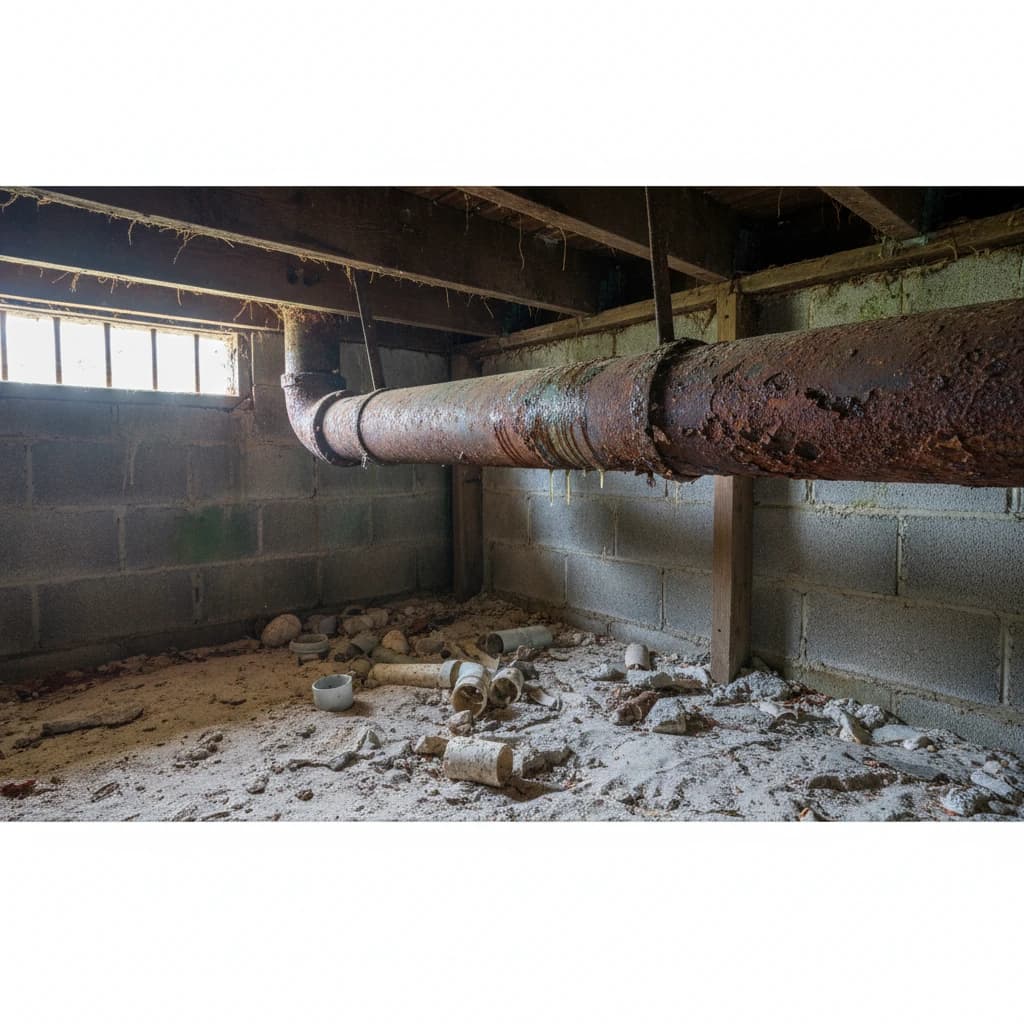
Cast iron drain pipe corrodes from the inside. Wastewater, hydrogen sulfide gas, and Florida's humidity attack the pipe wall over time, building up scale and thinning the metal until a section channels open, cracks, or collapses. Homes built through the 1970s and 1980s were plumbed with material expected to last 25 to 50 years, and a large share of older South Florida housing stock is now at or past that window. The slow part of the process, decades of corrosion, is what carriers point to. The fast part, the moment a thinned section finally breaches and discharges water under and around the home, is what most policies are written to cover.
Why cast iron claims get denied
Carriers' standard argument: "Cast iron pipes are at the end of their expected life. Failure is predictable deterioration, not a sudden accident. The wear-and-tear exclusion applies."
The counter: deterioration over decades and a sudden collapse at a specific point in time are distinguishable events. The corrosion is the long-term condition. The collapse, breach, or discharge is the sudden event. Most homeowner policies exclude the worn-out pipe itself while still covering the ensuing water damage that the failure causes. The fight is rarely about whether the pipe was old. It is about whether the resulting loss to your slab, walls, cabinets, and flooring is covered, and it usually is.
The wear-and-tear defense is a tactic, not a verdict. We treat it as the opening position it is.
Sudden-and-accidental versus wear-and-tear
This claim type lives and dies on one distinction. Policies that provide sudden-and-accidental discharge coverage protect against an abrupt, unexpected escape of water, even when the component that failed was aging. The carrier's job is to recharacterize a sudden discharge as a slow, continuous, long-term seepage so a different exclusion applies. Our job is to establish the opposite with physical evidence: a specific failure point, a discrete discharge, and damage consistent with an event rather than years of unnoticed weeping.
The same logic ties cast iron to its neighbors. The disputes you see here also drive plumbing leak claims, slab leak claims, pipe burst claims, and polybutylene pipe claims. The material differs. The coverage argument is the same family.
Tunneling, access, and tear-out coverage
Cast iron failures are usually below the slab, which makes access the most expensive part of the loss. Reaching a collapsed line means either tunneling under the foundation or breaking through the slab from above, then restoring everything that was removed to get there. Many policies include tear-out coverage that pays to access and repair the system that caused a covered water loss, and that access cost is frequently larger than the repair itself. Carriers often acknowledge the water damage while quietly excluding or shrinking the tunneling and restoration scope. We document access as part of the covered loss, not an afterthought.
Documentation that supports the claim
- Sewer-camera (leak detection) inspection showing the specific failure point
- Plumber's written diagnosis of the collapse or breach
- Timeline distinguishing gradual deterioration (long-term condition) from sudden collapse (event)
- Photos and video of the failure and the discharge path
- Moisture mapping and damage documentation on walls, floors, and cabinets
- Tunneling or slab-access scope from the plumbing or restoration contractor
- A line-item estimate that captures access, repair, dry-out, and restoration
The order matters. Get the camera inspection and a written cause-of-loss opinion before the line is repaired, because once the pipe is replaced the evidence of how it failed is gone.
Policy language matters
Review your policy carefully. Common relevant provisions:
- Sudden-and-accidental discharge coverage
- Tear-out coverage for access to repair
- Mold sublimit (often $10,000)
- Water damage limited coverage ($10,000 post-SB 2A policies)
- Matching requirement under Fla. Stat. 626.9744 for flooring and finishes
Newer Florida policies increasingly cap non-weather water losses, so the exact endorsement language often decides the recovery. Two homes on the same street with the same pipe failure can have very different outcomes based on which water-damage limitation rider is attached. We read the full form, not just the declarations page.
How carriers underpay these claims
Even when coverage is accepted, the payment is often short. Common tactics:
- Paying the water damage but excluding the tunneling and slab-access cost
- Limiting flooring replacement to the damaged room instead of matching contiguous areas
- Applying a water-damage sublimit that does not actually fit the policy form
- Treating consequential mold as outside the loss rather than a covered result of it
- Depreciating restoration that should be paid as replacement cost once incurred
If your offer feels low or the claim was denied or underpaid, the number is a starting point, not a final answer.
Florida deadlines you cannot miss
Florida law sets the clock on both sides. Your policy requires prompt notice of the loss, and the statutory windows for reporting property claims are firm, so report the failure as soon as you discover it. Once a claim is filed, Fla. Stat. 627.70131 requires the insurer to acknowledge it, begin investigating, and then pay or deny it within the statutory deadlines rather than leaving it open indefinitely. If a covered cast iron loss was closed for less than its full value, Florida also allows reopened and supplemental claims within the statutory window, so an underpayment is not necessarily the end of the matter. Missing your own notice deadline, however, can hand the carrier a clean defense, so timing is the one thing you control completely.