
Short answer: A Florida hurricane claim is a statute-governed, time-limited process with specific carrier obligations (Fla. Stat. 627.70131) and shortened notice deadlines (1 year for new claims, 18 months for supplemental, per Fla. Stat. 627.70132). Carriers commonly underpay by scope reduction, flood vs. wind causation disputes, and application of hurricane deductibles that often don't apply. Understanding the playbook, statutes, tactics, documentation, escalation paths, turns a hurricane claim from a stressful disaster into a managed process.
The first 72 hours
After a hurricane, your first 72 hours matter more than any other period of the claim.
Safety first
Address immediate safety hazards. Don't enter structurally compromised buildings. Document structural concerns externally.
Mitigate further damage
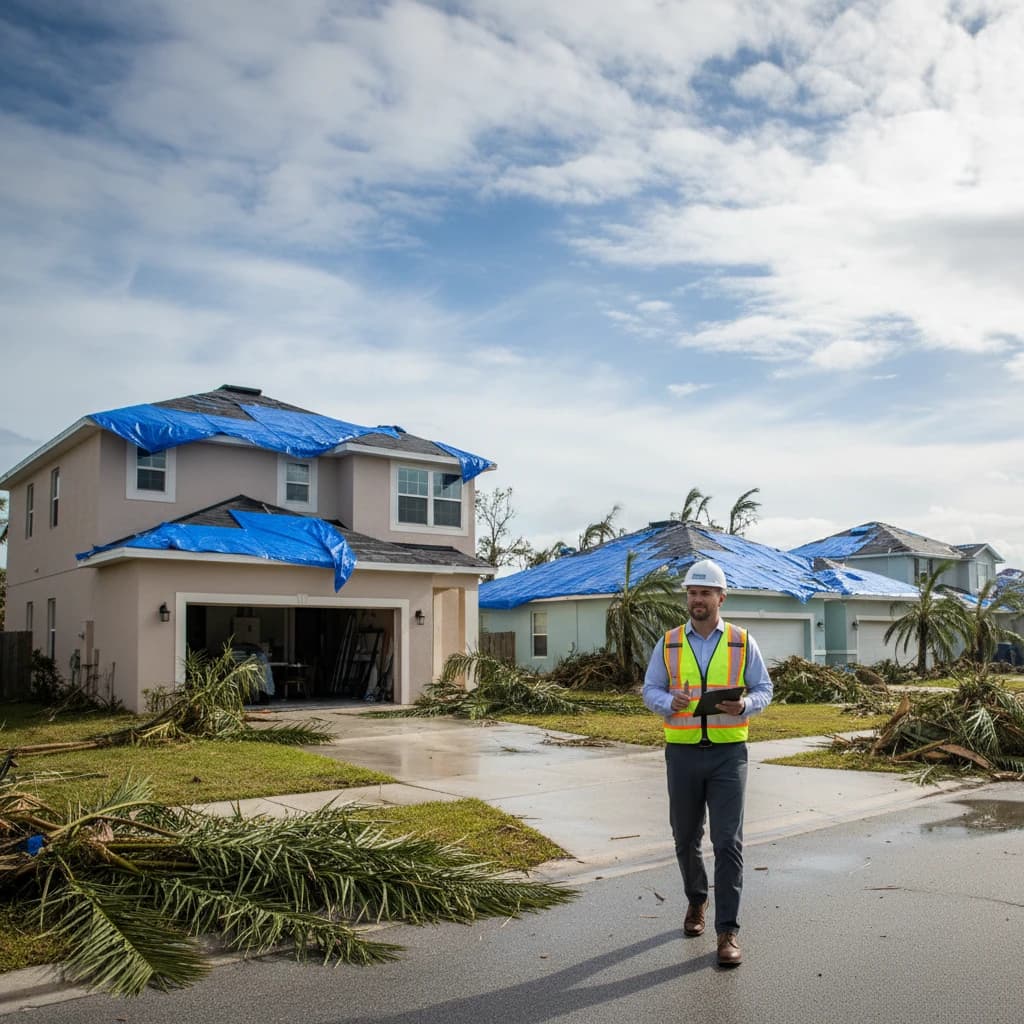
Florida policies require reasonable steps to prevent further damage. Tarp damaged roofs. Board up broken windows. Extract standing water if safe.
Document everything
- Photographs and video of all damage (exterior and interior)
- Date and time-stamp the documentation
- Inventory damaged contents
- Save damaged items (or photograph before disposing)
Notify the carrier
Florida Statute 627.70132 requires new-claim notice within 1 year, but prompt notice is always better. Notify within days, not weeks.
Retain documentation
Every receipt, tarps, temporary housing, emergency repairs, food (for ALE), additional transportation, becomes part of the claim.
Understanding your deductible
Florida homeowner policies typically carry two deductibles:
- Standard deductible (e.g., $500-$2,500) for most events
- Hurricane deductible (typically 2-5% of dwelling coverage) for hurricane events
For a home insured at $400,000 with a 2% hurricane deductible, that's $8,000 per hurricane event.
When the hurricane deductible applies
The policy language controls. Typically:
- Named hurricane by the National Hurricane Center triggers the deductible
- Some policies use a broader "named storm" trigger (tropical storms count)
- The deductible applies once per hurricane event (not per season)
When it doesn't apply
- Tornado damage outside hurricane events
- Non-named thunderstorm wind
- Lightning damage
- Water losses not driven by hurricane
Carriers sometimes apply hurricane deductibles incorrectly. Review the specific policy language against the specific event.
Documentation that matters
Damage documentation
- Date-stamped photos of every affected area
- Close-up photos of specific damage
- Wide shots showing context
- Video walkthroughs
Event documentation
- National Weather Service / National Hurricane Center reports
- Local news coverage
- Neighborhood damage patterns (photos of neighboring properties)
- Wind and rain data for the specific location
Condition documentation
- Pre-loss photos (insurance underwriting inspection, personal photos, real estate listing photos)
- Maintenance records
- Prior roof inspections
Financial documentation
- Every receipt (tarps, temporary housing, emergency repairs)
- Contractor estimates
- Demolition and haul-away records
Florida statutory response deadlines
Under Fla. Stat. 627.70131:
Statutory interest accrues on late payments from the date of notice. Missed deadlines are grounds for DFS complaint and CRN.
OIR data: what carriers do
Per Florida Office of Insurance Regulation:
- Hurricane Helene (2024): 33% of closed claims without payment denied as below-deductible, 20% on flood grounds
- Hurricane Milton (2024): 41% of closed claims without payment denied as below-deductible
These numbers mean many initial denials are standard carrier practice, not unique to your claim. They're also often contestable.
Common carrier tactics and how to counter them
Tactic 1: Scope reduction
Carrier's Xactimate estimate omits line items (demo, drying, protection, code upgrades, matching). Counter: Full Xactimate re-estimate from a licensed public adjuster.
Tactic 2: Wind vs. flood causation
Carrier attributes interior damage to flood (excluded) rather than wind-driven rain (covered). Counter: Engineering analysis of water-entry points, timeline, and structural evidence. NFIP claim for the flood-caused portion runs in parallel.
Tactic 3: Hurricane deductible misapplication
Carrier invokes hurricane deductible for non-hurricane damage. Counter: Policy language review; event-specific documentation.
Tactic 4: Wear-and-tear characterization
Carrier attributes roof or structural damage to age rather than the event. Counter: Pre-loss condition documentation, weather correlation, independent expert analysis.
Tactic 5: Delay
Statutory response deadlines missed. Counter: Written demands citing Fla. Stat. 627.70131. DFS complaint. Civil Remedy Notice.
The escalation path
- Initial claim submission and negotiation. Full documentation, Xactimate estimate, regular follow-up.
- DFS complaint at MyFloridaCFO.com when statutory deadlines slip.
- DFS mediation under Fla. Stat. 627.7015 for amount-of-loss disputes.
- Appraisal under the policy's appraisal clause for amount disputes.
- Civil Remedy Notice under Fla. Stat. 624.155 when bad-faith conduct documented (60-day cure window).
- Litigation with counsel when cure doesn't happen.
Supplemental and reopened claims
Found additional damage after initial settlement? You have options under Fla. Stat. 627.70132:
- Reopened claim: 1 year from date of loss
- Supplemental claim: 18 months from date of loss
Both are real paths to additional recovery. Ocean Point handles both as specific services.
The Ocean Point Claim Protocol™
Our 7-stage methodology for hurricane claims (and property claims generally):
- Free claim review
- Retention (contingency, 10-day right of cancellation)
- Inspection and documentation
- Policy review
- Xactimate estimate preparation
- Submission and negotiation
- Resolution (direct, appraisal, mediation, CRN, or litigation coordination)
Learn more about the Ocean Point Claim Protocol™ →
Key statutes to know
- Fla. Stat. 627.70131: carrier response deadlines
- Fla. Stat. 627.70132: notice deadlines
- Fla. Stat. 627.7142: Homeowner Claims Bill of Rights
- Fla. Stat. 624.155: bad faith and CRN
- Fla. Stat. 626.9744: matching
When to retain representation
Any one of these:
- Significant claim (>$25,000 expected recovery)
- Denied claim
- Underpaid claim (gap >$10,000 from your expectation)
- Delayed beyond statutory deadlines
- Complex coverage issues (wind/flood allocation, condo coverage)
- You're overwhelmed by the process
Ocean Point provides a free claim review for every scenario. If representation isn't likely to help, we tell you so.
Talk to us
Free claim review · Toll-free (888) 824-1306 · Licensed Florida public adjusters · 21 years · 500+ mediations