
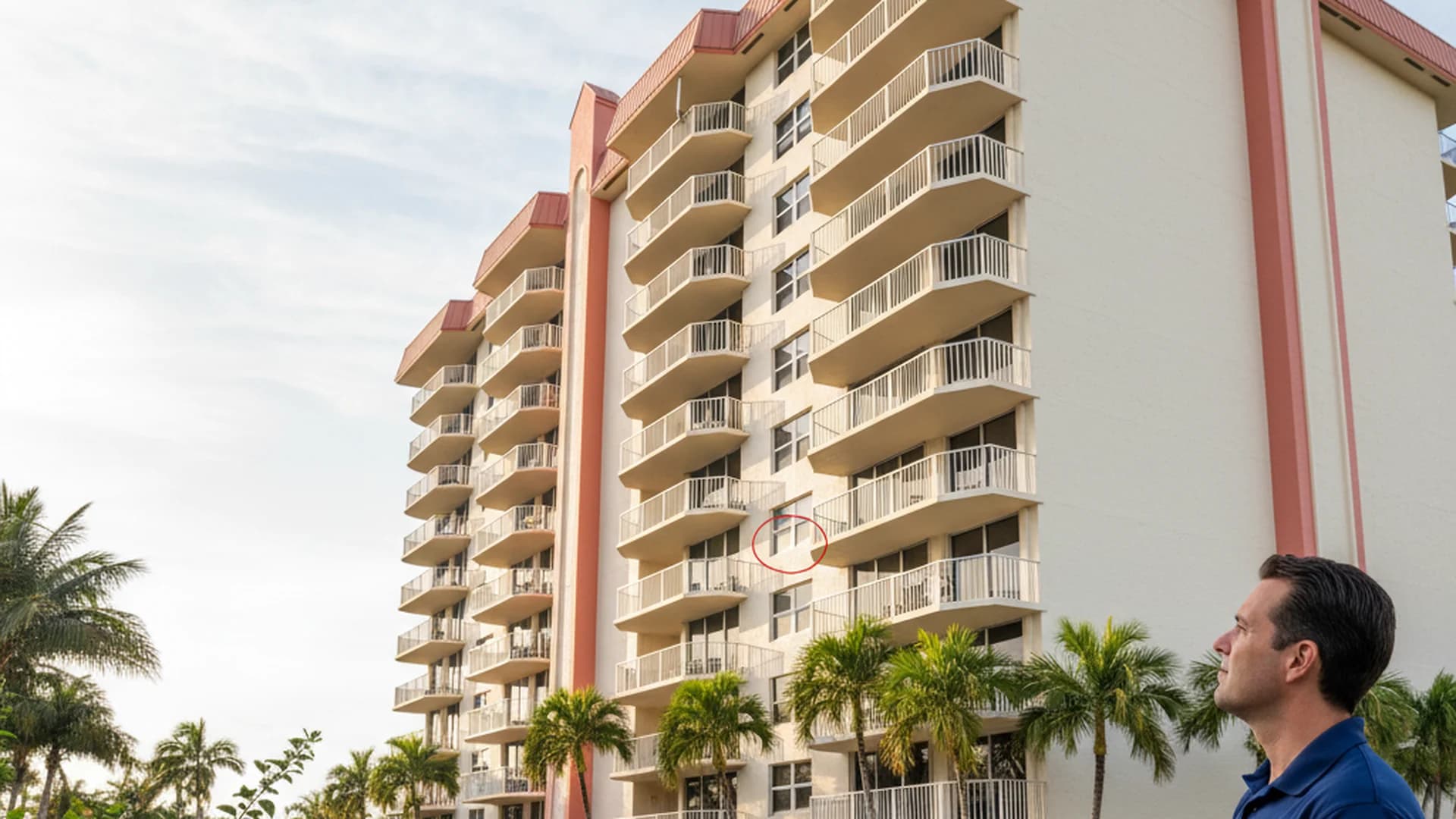
Short answer: Under Florida's Chapter 718, a condominium master policy must cover the building as originally constructed, while each unit owner's HO-6 covers betterments, contents, loss of use, and special assessments. When master and HO-6 carriers dispute the allocation, Fla. Stat. 627.70131 (2022) still binds the carrier to acknowledge in 7 days and pay or deny within 60 days. Coordinating both claims is what keeps either carrier from shifting the loss to the other.
What do we handle?
We represent both sides of a condo loss: the association and the unit owners.
- Multi-family residential condominium master-policy claims
- HOA master-policy claims (when the HOA carries property coverage)
- Mixed-use condominium master-policy claims
- Townhome / villa / cluster-condo master-policy claims
- Unit-owner HO-6 claims that interact with a master claim
- Special assessment recovery via loss-assessment coverage
- Board fiduciary obligations and pre-litigation positioning
How does the master-policy / HO-6 split work?
Under Fla. Stat. 718.111(11), a Florida condominium association's master policy must cover the building as originally constructed, and as later improved by the developer or association, including everything within "the unboundaries of each unit as originally installed." The unit owner's HO-6 covers everything else: betterments and improvements, contents, loss of use, and liability.
In practice, the master policy typically covers:
- Structural elements (walls, floors, roof, foundation)
- Building systems (common-area plumbing, electrical, HVAC up to the unit)
- Drywall, subfloor, basic flooring as originally installed
- Common areas (lobbies, hallways, amenities)
The HO-6 typically covers:
- Cabinetry, countertops, upgraded flooring beyond original spec
- All contents, furnishings, electronics
- Loss of use / ALE while the unit is uninhabitable
- Unit-owner liability
- Loss assessment, coverage for special assessments levied by the association for an uncovered or under-covered loss
| Loss component | Master policy (Chapter 718) | Unit-owner HO-6 |
|---|---|---|
| Structure: walls, floors, roof, foundation | Covered | Not covered |
| Building systems to the unit (plumbing, electrical, HVAC) | Covered | Not covered |
| Drywall, subfloor, basic flooring as originally installed | Covered | Not covered |
| Cabinetry, countertops, upgraded flooring beyond spec | Not covered | Covered (betterments) |
| Contents, furnishings, electronics | Not covered | Covered |
| Loss of use / ALE while the unit is uninhabitable | Not covered | Covered |
| Special assessment for an uncovered loss | Not covered | Covered (loss assessment) |
Key takeaway: Chapter 718 sets the master policy's floor for building elements, but everything beyond original construction falls to the unit-owner HO-6, which is why the two claims must be filed and coordinated together.
The boundaries vary by association declaration. Read it.
Why are condo claims commonly disputed?
- Allocation disputes between master and HO-6 carriers. Each tries to assign the damage to the other.
- Coverage-type disputes within the master. Was that water damage a covered cause (covered) or a maintenance issue (excluded)? The master policy's named-perils vs all-risk form matters enormously.
- Statute-imposed minimums. Fla. Stat. 718.111(11)(f) requires the master to cover building elements regardless of the master carrier's preferred construction.
- Reserve and assessment pressure. Boards face fiduciary pressure to limit assessments, and may be tempted to under-claim or settle short to avoid a big special assessment.
- Documentation complexity. Multi-unit losses require coordinated documentation across owners, the manager, and contractors.
What coverage parts are in a typical Florida condo master policy?
A typical master policy bundles several coverage parts beyond raw building coverage.
- Building coverage, the structure per the declaration
- Business interruption / loss of rents, for assessable income
- Ordinance or law, code upgrades during repair
- Equipment breakdown, covered separately or as endorsement
- Wind / named-storm, often a separate deductible, frequently a percentage deductible
- Flood, almost always separate (NFIP or RCBAP for condos)
Which Florida statutes apply to condo claims?
Five statutes shape almost every Florida condo claim.
- Fla. Stat. 718.111(11), master-policy requirements
- Fla. Stat. 718.112, board fiduciary duties
- Fla. Stat. 718.115, common expenses and assessments
- Fla. Stat. 627.70131 / 627.70132, carrier response deadlines and supplemental-claim windows
- Fla. Stat. 624.155, bad faith and CRN
How does Ocean Point handle condo/HOA claims?
Our condo workflow starts with the declaration and keeps the master and HO-6 claims aligned.
- Declaration review. Every claim starts with a deep read of the declaration of condominium and the master policy, without this, allocation is guesswork.
- Master-and-HO-6 parallel intake. Unit owners with damage are coordinated with the association claim so HO-6 carriers and the master carrier can be put on coherent notice simultaneously.
- Multi-unit damage mapping. We document unit-by-unit, common area-by-common area, with floor plans, photographs, and Xactimate measurement.
- Board interface. We work with the board, the property manager, and (when needed) the association's general counsel, not around them. Fiduciary documentation is preserved for the file.
- Loss-assessment positioning. When a special assessment looks likely, we structure the claim and supporting documentation so unit-owner loss-assessment coverage can be properly invoked.
- Escalation. Appraisal, mediation, CRN, and coordination with counsel when needed.
Who this is for, and when should a board handle it alone?
A single-unit, single-cause loss that sits cleanly inside one policy, with no allocation fight and damage well under the deductible, is one a board or manager can often handle directly. Bring in a public adjuster when the master and HO-6 carriers are shifting the loss between them, when a percentage named-storm deductible pushes six figures onto the association, when a special assessment looks likely, or when board members face fiduciary exposure for under-claiming. Public adjuster fees in Florida are capped by law (Fla. Stat. 626.854(11)) at 20% (10% for declared-emergency claims in the first year). Bottom line: the more units, carriers, and assessment dollars in play, the harder it is for a board to self-represent responsibly.