Short answer: A Florida fire claim covers far more than the burned structure: smoke and soot contamination, heat damage, water used to extinguish the fire, contents, additional living expense, and code upgrades. On a total loss of your home, [Fla. Stat. 627.7011](/resources/florida-statutes/627-7011-valued-policy-replacement-cost/) requires the insurer to pay full replacement cost with no depreciation held back. We document every category so nothing is quietly scoped away.
What a Florida fire claim covers
A covered fire loss almost never stops at the headline structural damage. One event usually opens several distinct categories of recoverable loss at once:
- Structural damage: burned framing, decking, roofing, and the exterior envelope
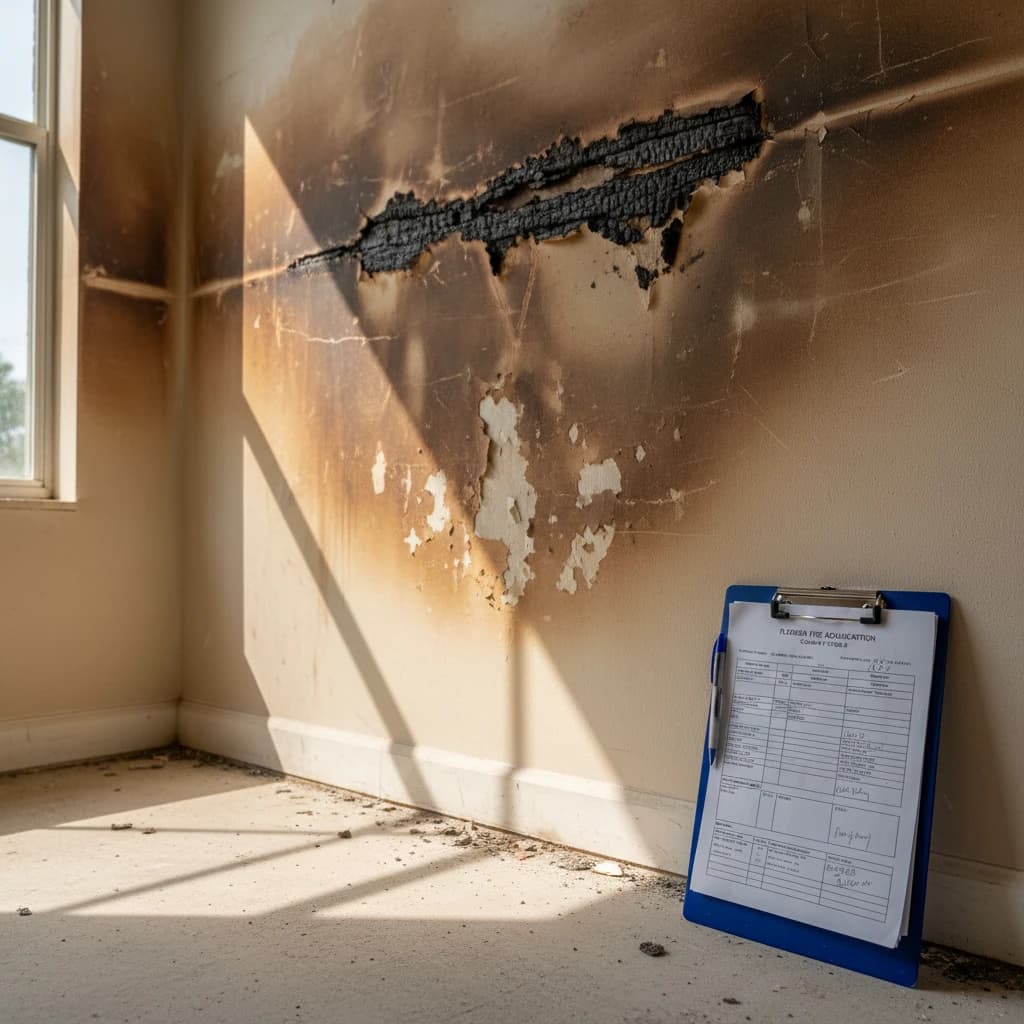
- Smoke and soot contamination: walls, ceilings, HVAC systems, insulation, fabrics, and contents throughout the property, often well beyond the visibly burned area
- Heat damage: warped flooring, cracked tile, compromised wiring, and damaged plumbing in rooms that never caught fire
- Water damage: from firefighting efforts, covered under most Florida HO-3 policies as an incident of the fire
- Contents and personal property: destroyed, smoke-affected, or removed during mitigation
- Additional living expense (ALE): hotel, food, and transportation while the home is uninhabitable
- Code upgrades: law-and-ordinance coverage triggered when the rebuild must meet current code
Treating these as one number on a single estimate is how money gets left behind. Each category is documented separately.
How smoke and soot travel beyond the burn
The most underestimated part of a fire claim is what you cannot see. Heat drives smoke and soot through HVAC ductwork, wall and ceiling cavities, and around door frames into rooms far from the flames. Soot is acidic and corrosive; left in place it keeps etching glass, pitting fixtures, and embedding odor into porous materials. Carriers frequently scope only the rooms with visible char and call the rest "cleanable."
Proving the true extent takes thermal imaging, surface wipe sampling, and industrial-hygiene assessment. Where soot has affected a continuous run of flooring, cabinetry, or trim and only part can be cleaned or replaced, Florida's matching requirement under Fla. Stat. 626.9744 can support restoring a uniform appearance rather than a patchwork: a legitimate driver of additional recovery.
Why fire claims are commonly underpaid
- Smoke and soot scope reduction. Carriers scope only the visibly burned rooms. Thermal and air-quality documentation captures contamination that traveled through HVAC and wall cavities throughout the home.
- Contents lowballed. Carrier depreciation schedules routinely undervalue household goods. An itemized claim with replacement-cost documentation can produce 30-100% more recovery on the contents portion alone (individual results vary).
- Code upgrades omitted. Rebuilding an older home to the current Florida Building Code adds real cost. Law-and-ordinance coverage pays that difference, but only when it is claimed line by line.
- Water-from-firefighting excluded. Some carriers wrongly treat firefighting water as a separate peril, when Florida policy language typically covers it as part of the fire loss.
- ALE cut short. Carriers frequently end ALE before the period of restoration, leaving policyholders paying out of pocket while the home is still uninhabitable.
If your offer already feels low, our underpaid claim and denied claim walkthroughs explain how we reopen and rebuild the file.
Florida deadlines and statutes that protect you
Fire claims run on a clock, and missing a deadline hands the carrier an easy defense.
- Notice deadline. Under Fla. Stat. 627.70132, a property insurance claim must generally be reported within one year of the date of loss, with a further window for a supplemental or reopened claim. Delay gives the carrier ammunition.
- The 60-day pay-or-deny rule. Under Fla. Stat. 627.70131, the insurer must acknowledge, investigate, and pay or deny the claim within 60 days of notice, absent factors beyond its control. A claim open past that window is worth pressing.
- Public adjuster fees are capped by statute. Florida law (Fla. Stat. 626.854) limits what a public adjuster can charge, and Ocean Point works on a no recovery, no fee basis, so representation does not erode your settlement.
Contents and personal property
Contents are where fire claims most often hemorrhage value, because the burden of proof falls on the policyholder. We build a room-by-room inventory with photographs, descriptions, age, and replacement cost, then push for replacement-cost settlement rather than deep depreciation on items you have to buy new today. Goods removed during mitigation, smoke-affected items that cannot be safely restored, and electronics exposed to soot all belong in the claim. See our personal property and contents approach for how we value the full inventory.
Additional living expense (ALE)
If the fire makes your home uninhabitable, ALE covers the added cost of living elsewhere: temporary housing, meals above your normal grocery spend, transportation, pet boarding, and storage. The key is a running day-count tied to the real period of restoration, with receipts from the moment of loss forward. Carriers routinely truncate ALE; we track it against the actual rebuild timeline. Our residential loss of use and ALE page covers what qualifies.
How Ocean Point handles fire claims
The first inspection is the most consequential moment in a fire claim, so the early hours matter: secure the property, keep every receipt, preserve damaged items until the adjuster has seen them, and do not sign an Assignment of Benefits or a release without review. Our guide on what to do immediately after fire damage covers that sequence. Our process from there:
- Emergency response: we coordinate with the mitigation contractor, the fire marshal, and the carrier from day one.
- Full scope documentation: photography, thermal imaging, air-quality sampling, and a room-by-room contents inventory.
- A detailed estimate covering structural, contents, smoke and soot cleaning, and code-upgrade scope.
- ALE tracking with receipts and a running day-count against the period of restoration.
- Escalation when the carrier will not pay fairly. Our full method is the Ocean Point claim protocol.
Appraisal, mediation, or litigation
When the carrier acknowledges coverage but disputes the amount, appraisal is often the fastest path: each side names an appraiser, an umpire resolves differences, and the award is binding on amount. For smaller valuation gaps, DFS mediation can move the file, and where there is a clear pattern of bad-faith handling, a Civil Remedy Notice puts the carrier on formal notice. Our public adjuster vs. attorney comparison explains which track fits.
Fire claim questions we hear most
Does my policy cover water damage from the fire department?
In most Florida HO-3 policies, yes. Water used to extinguish a covered fire is treated as part of the fire loss, not a separate excluded peril. If a carrier carves it out, that position is usually wrong.
The carrier only scoped the burned rooms. Is that complete?
Rarely. Smoke and soot migrate well beyond the flames, so a scope limited to visibly charred rooms typically misses HVAC contamination and affected contents in adjacent areas.
Who leads fire claims at Ocean Point
Eli Goins (FL DFS #P159790) leads fire and smoke claims. Contents and ALE documentation are supported by our administrative team.