
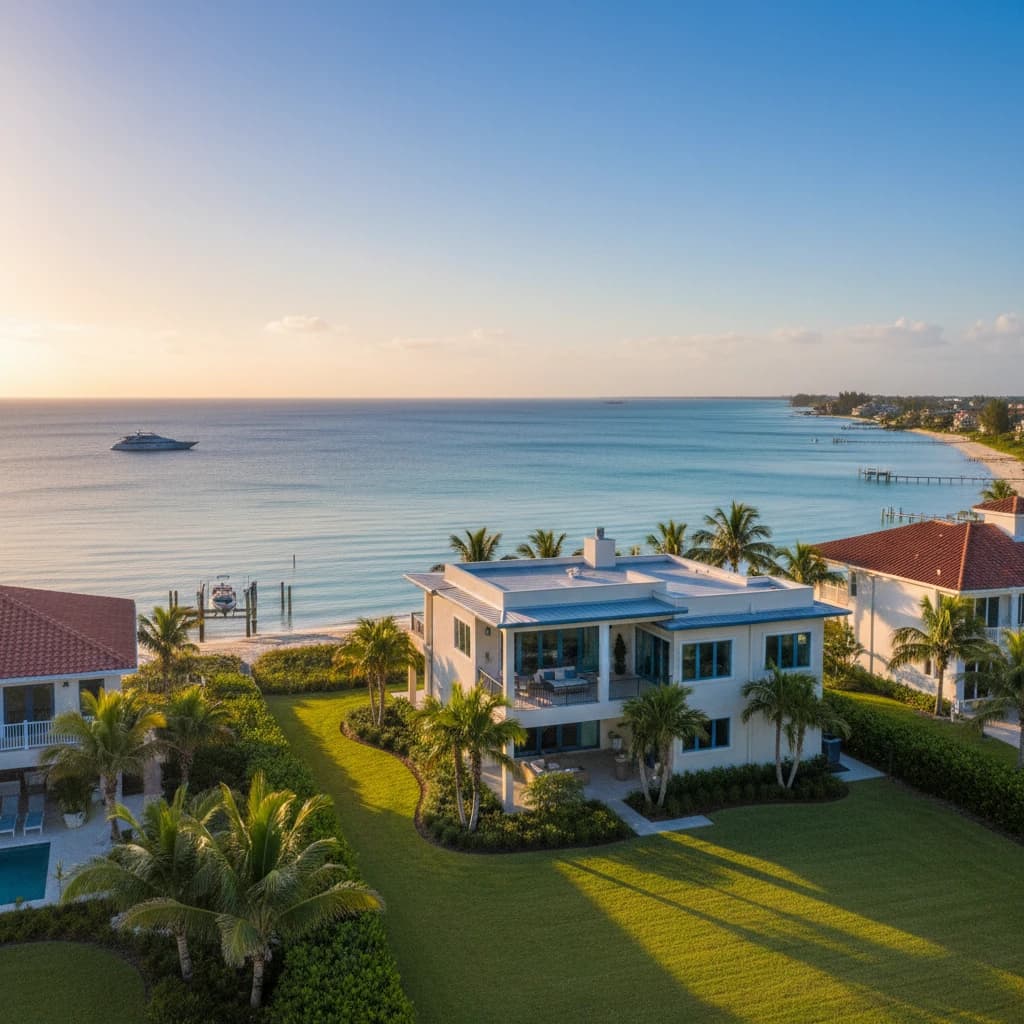
Short answer: A Marco Island public adjuster represents you, not your insurer, on Collier County property claims, and under Fla. Stat. 626.854 the fee is capped and contingent. Hurricane Ian made an early landfall near Marco in 2022, and the island's high-rise condos, canal-front homes, and vacation rentals produce large common-element and loss-of-use claims carriers routinely underscope. Ocean Point Claims (FL DFS #W829547) documents the full building and common-element loss and holds carriers to the deadlines in Fla. Stat. 627.70131.
Hurricane Ian and the storm record on Marco Island
When Hurricane Ian (2022) crossed the Florida coast, it made an initial landfall near Marco Island before continuing north toward Cayo Costa. The island took substantial wind, storm surge, and roof damage in that first contact, and many Collier County policyholders are still reconciling what their carriers paid against what the loss actually required. Marco is the largest of Florida's Ten Thousand Islands, a barrier-island community at the southern end of the Gulf Coast where a direct or near-direct hit drives high-dollar claims across condominiums, waterfront single-family homes, and vacation rentals at the same time. Ocean Point Claims represents the policyholder on those files, never the insurance company.
A barrier-island building stock that complicates every claim
Marco Island concentrates exactly the property types insurers fight hardest. The island carries a dense stock of mid-rise and high-rise condominiums, substantial waterfront single-family homes along its canals and the Gulf, and a large share of seasonal and vacation-rental units. Each raises its own valuation problems. Condo association losses on Marco routinely involve large common-element scope, roofs, building envelopes, elevators, pool decks, seawalls, and shared mechanicals, where the line between association and unit-owner responsibility is rarely clean. Waterfront homes face wind-driven rain, surge intrusion, and salt exposure that a fast adjuster walkthrough tends to underread. Vacation rentals add loss-of-use and business-income questions on top of the physical repair. None of that gets captured by a carrier estimate built in an afternoon.
The claims we handle for Marco Island policyholders
We take hurricane and windstorm damage, storm-surge and water intrusion, roof claims, and the condo association and common-element losses that define so much of the island's exposure, along with the unit-owner claims that sit underneath them. We also take denied claims, underpaid claims, and claims a carrier has let stall past the timelines Florida sets. Under section 627.70131, your insurer faces statutory deadlines to acknowledge, investigate, and pay a claim, and we use that clock when an adjuster goes quiet. If you already settled and later found hidden surge or roof damage, section 627.70132 sets the window to file a supplemental or reopened claim, and we document the new scope to support it.
Why Marco Island settlements come up short
Underpayment on Marco usually traces to scope, not luck. A carrier estimate often misses surge-driven moisture inside wall cavities, undervalues tile and metal roof systems common on the island, treats salt-corroded components as wear rather than storm damage, and prices common-element repairs as if a single unit were affected. Matching is another recurring fight. When wind or water destroys part of a roof, tile field, or interior finish and the remaining material no longer matches, section 626.9744 requires the carrier to account for reasonable matching rather than patching one slope or one room and calling it whole. On large condo buildings, the gap between a patch and a uniform repair can be the entire dispute. No-pay outcomes are common statewide: FLOIR reports that roughly 38% of closed Hurricane Milton claims and 35% of closed Hurricane Helene claims were closed without any payment, most often on below-deductible or flood findings (floir.gov), the kind of call a fully documented common-element scope is built to rebut.

How Ocean Point builds and pushes the claim
We start by reading your actual policy, the declarations, endorsements, hurricane and flood deductibles, and any sublimits, so the demand is built on your coverage and not a generic template. Then we document the loss in full: field measurements, moisture readings, photographs, roof and envelope assessments, association engineering reports where common elements are involved, and a line-item estimate that reflects Marco Island labor and material costs. We present that scope to the carrier, answer its reinspections, and keep the file moving against the statutory clock. When an insurer keeps acting in bad faith, ignoring deadlines, lowballing without basis, or denying covered damage, section 624.155 allows a Civil Remedy Notice, a formal filing that puts the carrier on notice and creates a path to additional remedies. Ocean Point is headquartered in Hobe Sound and licensed to work claims statewide, including across Collier County alongside our work in Naples and Fort Myers.
Fees, timing, and how to reach us
Florida public adjusters work on contingency under section 626.854, so our fee comes as a percentage of what we recover for you and nothing is owed up front. That statute also gives you a 10-day right to cancel a public adjuster contract signed in the aftermath of a declared emergency, so there is no pressure in calling early. The sooner we document a Marco Island loss, the harder it is for a carrier to argue the damage came from something else. Call Ocean Point Claims at (888) 824-1306 or reach us through our contact page. We are licensed in Florida under DFS #W829547, you can see every area we serve on our locations page, and our work across the state is outlined on the Florida statewide public adjuster page.