
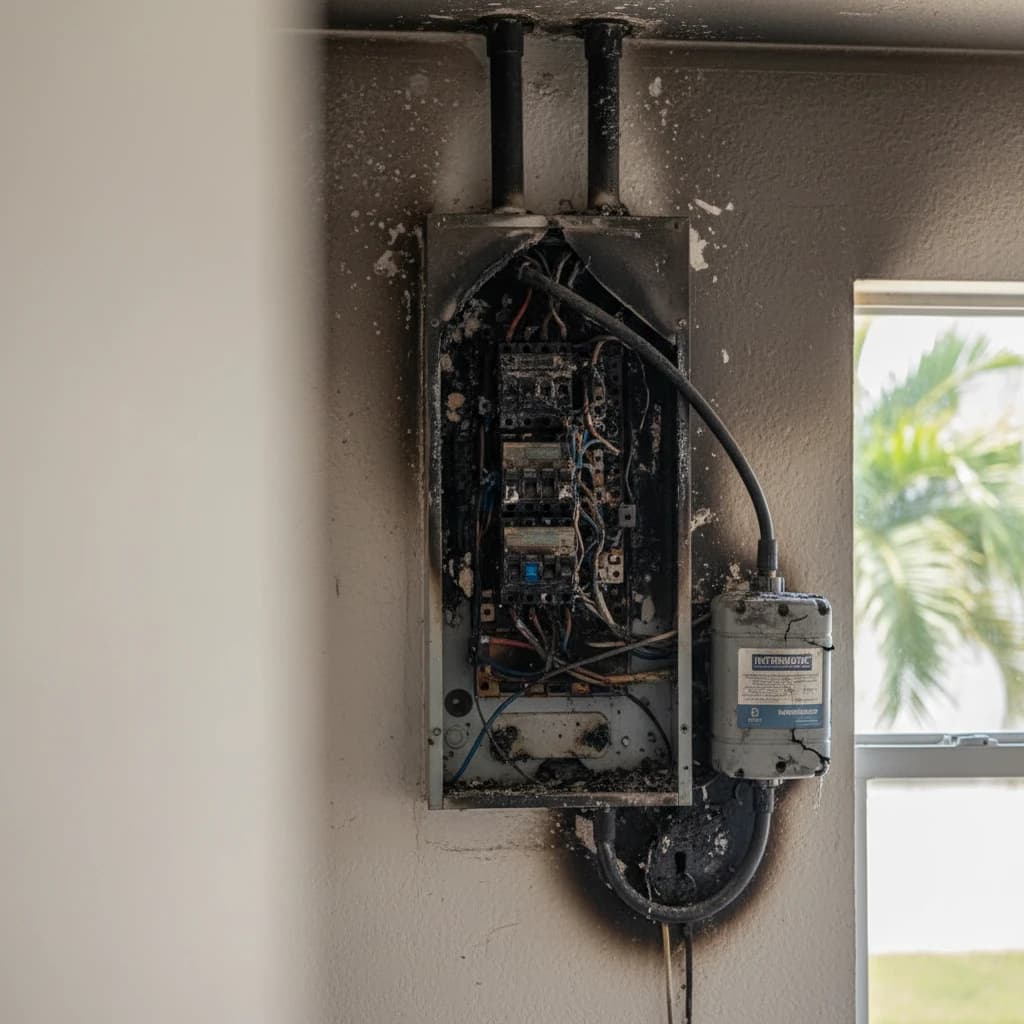
Short answer: Yes, lightning is a named peril in virtually every Florida homeowner policy, and resulting power surges are usually covered when they follow a covered cause. These claims are rarely denied outright; they are underpaid on scope. Your insurer must pay or deny within 60 days under [Fla. Stat. 627.70131](/resources/florida-statutes/627-70131-claim-response-deadlines/), and repairs to the dwelling and its permanently installed systems are paid at replacement cost under [Fla. Stat. 627.7011](/resources/florida-statutes/627-7011-valued-policy-replacement-cost/).
What we handle
- Direct lightning strike damage
- Power surge damage following a strike or grid event
- HVAC compressor and condenser damage
- Appliance damage (ranges, refrigerators, dishwashers, washers and dryers)
- Electronics damage (televisions, computers, smart-home systems, security and AV equipment)
- Electrical panel, breaker, and branch-wiring damage
- Well-pump, pool, and irrigation equipment damage
- Roof damage from strike impact, and resulting attic or framing scorching
Florida sits in the most lightning-active region of the United States, and the Tampa Bay corridor is frequently called the lightning capital of the country. A single nearby strike can push a destructive voltage spike through the power lines, the data lines, and even the ground itself, frying equipment in a house that was never physically hit. Because the damage is often invisible from the outside, these claims are routinely underpaid on scope, not denied outright.
How lightning and surge damage actually happens
A direct strike is the obvious case: a bolt hits the roof, a tree, or the service mast, and the energy travels into the structure. But most surge claims come from indirect events. A strike a block away induces a spike on the utility line, or a grid fault sends an over-voltage transient into the home. That spike enters through the breaker panel and races to every connected device. Sensitive electronics fail first, but motors and compressors take cumulative damage too, which is why a claim can involve both an instantly dead television and an HVAC compressor that limps along for days before failing.
Coverage basics
- Lightning is a named peril in virtually every Florida homeowner policy
- Power surge is typically covered when it results from a covered cause such as lightning or wind
- Grid-caused or utility-side surge may or may not be covered depending on policy language and any service-line or equipment-breakdown endorsements
- Damage that meets the sudden and accidental standard is generally inside coverage, while gradual deterioration is not
The coverage question usually is not whether lightning is covered. It is whether a particular failed component was damaged by the event or was already failing. That distinction is where carriers concentrate their underpayment.
How carriers underpay lightning and surge claims
- Age versus event. A failed HVAC compressor or pool pump is attributed to age or normal wear and tear rather than the strike, even when the unit ran fine the day before the storm.
- Item-by-item scoping. The carrier replaces the one obviously dead device and excludes the rest of a connected system, ignoring that a surge commonly damages multiple components on the same circuit.
- Repair instead of replace. An adjuster authorizes a control board swap on a unit whose windings or compressor were also compromised, leaving the homeowner with a partial fix that fails again.
- Hidden and latent damage ignored. Surge damage to branch wiring, breakers, or low-voltage control systems often does not show until weeks later, so a first inspection that finds "only the TV" can drastically undervalue the true loss.
- Depreciation overreach. Recoverable depreciation is withheld or actual-cash-value figures are pushed down on electronics and appliances.
When you believe the offer is low for these reasons, our claim underpaid process is built to reopen the scope.
Proving a lightning or surge event
Carriers want evidence that an event actually occurred. The good news is that this is documentable:
- Lightning strike density data confirming activity near your address on the loss date
- Utility outage or fault records, when a grid event is involved
- An electrician's written diagnosis tying the failures to a transient over-voltage rather than age
- An HVAC technician's report identifying surge or strike damage to the compressor or controls
- Photographs of scorching, melted contacts, or burst components
Independent diagnostic reports carry far more weight than a homeowner's description, and they often flip a denial into a payment.
Documentation checklist
- Photographs and video of every damaged item, including model and serial numbers
- Appliance and electronics repair or replacement diagnoses
- Receipts for any items replaced immediately, which are commonly excluded from settlement if not documented
- Utility report when the loss is grid-surge related
What to do first
- Document everything before you discard or replace anything. A dead unit hauled to the curb is evidence that no longer exists.
- Have a licensed electrician and the relevant trade technician diagnose the failures in writing.
- Keep damaged items, or at least their model and serial information, until the claim resolves.
- Report the loss to your carrier promptly and keep a written record of every contact.
- Get a full inspection of connected systems, because the visible damage is rarely the whole loss.
Florida deadlines you should know
Florida law gives property claims a defined timeline. Under Fla. Stat. 627.70131, your insurer must acknowledge your claim and, in most cases, pay or deny it within 60 days of receiving notice, absent factors beyond its control. If new damage surfaces after the first payment, which is common with latent surge damage, a supplemental claim may be available within the statutory window under Fla. Stat. 627.70132. Public-adjuster fees in Florida are capped by statute under Fla. Stat. 626.854, and Ocean Point works on a no recovery, no fee basis.
Appraisal versus litigation
When the dispute is purely about the amount of a covered loss, the policy's appraisal clause is often the faster path. Each side names an appraiser, the two select a neutral umpire, and a binding value is set. Our appraisal and umpire team handles this for surge scope disputes. When the carrier denies coverage outright or acts in bad faith, that is a legal question rather than a valuation one, and we coordinate accordingly.
Will my older HVAC be covered if lightning killed the compressor?
Coverage turns on causation, not age alone. If diagnostics show the failure resulted from the event rather than gradual wear, the loss is generally covered, and depreciation applies to value, not to coverage.
What if I already threw out the damaged equipment?
It makes the claim harder but not hopeless. Photographs, repair invoices, serial records, and a technician's account can still support the loss.
How we help
Ocean Point documents the full scope of a lightning or surge loss, commissions the independent diagnostics carriers respect, and presents a complete, defensible claim. Our public adjusting team represents the policyholder.