
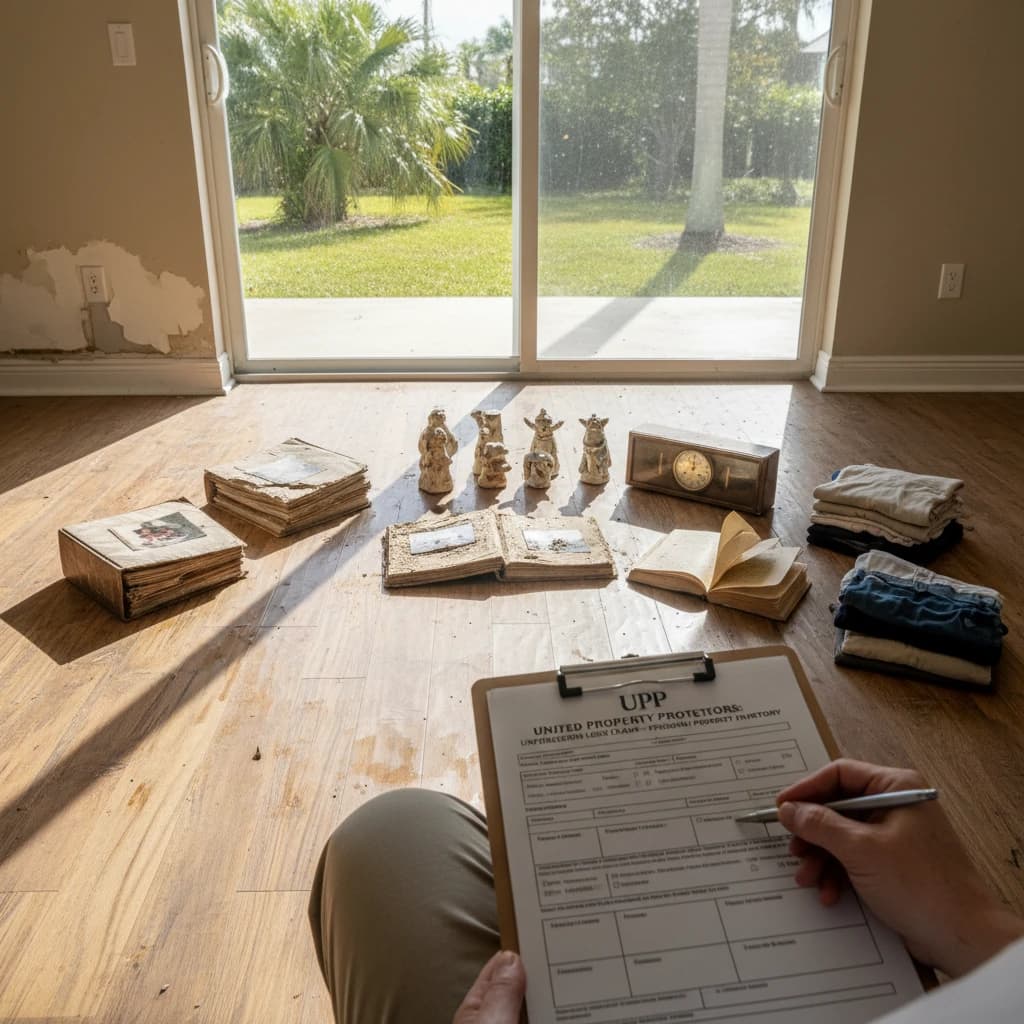
What Coverage C covers
Most Florida HO-3 policies provide personal property coverage at 50-75% of the dwelling coverage amount. For a home insured at $400,000 dwelling, that is $200,000-$300,000 in contents coverage. Coverage C, also called unscheduled personal property (UPP), protects the movable belongings inside your home rather than the structure itself. Typical items:
- Furniture
- Electronics (TVs, computers, audio)
- Appliances (non-built-in)
- Clothing and textiles
- Kitchen contents (dishes, cookware, small appliances)
- Books, art, media
- Outdoor equipment (grills, patio furniture, lawn tools)
- Tools and sporting equipment
A contents claim almost always rides alongside a structural claim from fire, water damage, or a storm, and the two should be documented together rather than treated as one lump sum.
Sublimited categories
Most policies cap recovery on certain high-value categories unless those items are specifically scheduled. The exact caps vary by carrier and form, but commonly sublimited categories include:
- Jewelry, watches, and furs: capped at a relatively low aggregate, especially for theft
- Firearms and related equipment: a separate, modest aggregate cap
- Cash, coins, and precious metals: a very low cap
- Business property kept in the home: a limited amount
- Silverware, goldware, and pewterware: a category-specific cap
- Electronic data and records: often excluded or sharply limited
High-value items should be scheduled (listed individually) on a personal articles floater to move them out from under the sublimit. When a loss involves jewelry, firearms, or collectibles, the first question we ask is whether a floater exists, because scheduled property frequently never appears on the carrier's opening contents offer.
ACV vs RCV and the replacement-cost holdback
This is where most contents money is won or lost. A replacement-cost policy pays in two stages. First the carrier issues actual cash value (ACV): the replacement cost of each item minus depreciation for age, wear, and condition. The difference between ACV and full replacement cost is held back, the recoverable depreciation, and released only after you replace the item and submit proof.
That holdback is routinely forgotten. Homeowners cash the ACV check, assume the claim is closed, and never claim the second payment they are owed. On a large contents loss the recoverable depreciation can be a substantial share of the total. We track every item from ACV through replacement so the holdback is documented, invoiced, and collected before the policy's replacement deadline expires. If your policy is ACV-only, depreciation is permanent, making the depreciation argument the entire fight.
Why contents claims are commonly underpaid
- No real inventory submitted. A handwritten list of "furniture, TV, clothes, kitchen stuff" gets depreciated heavily. An itemized, photographed inventory with replacement-cost quotes recovers far more than a vague summary.
- Aggressive depreciation. Carriers apply generic tables that overdeplete. Item age, condition, and actual useful life are negotiable.
- RCV holdback not released. The second payment is often never pursued.
- Scheduled items missed. Floater items sit on a separate schedule that never surfaces on the carrier's first offer.
- Smoke and water-contaminated contents written off as cleanable. Soft goods exposed to smoke or moisture often cannot be restored economically.
If your contents offer feels low against what you actually lost, our underpaid claim review is built for exactly this gap.
Depreciation deserves its own emphasis: it is an estimate, not a fixed rule, and it is the most contested line in a contents claim. Carriers lean on standardized life-expectancy tables and a default wear-and-tear assumption to shrink the ACV payment. We challenge it item by item: a lightly used appliance or a maintained piece of furniture should not be depreciated as if it were at the end of its life. The carrier's wear-and-tear defense is a starting position, not the final word, and documented age and condition routinely move the number.
Smoke, water, and mold-affected contents
Contents that survive the visible event can still be a total loss. Smoke residue and odor penetrate fabrics, upholstery, mattresses, and electronics in ways that surface cleaning does not fix. Water-soaked porous materials, and any contents that later grow mold, frequently cannot be restored to a sanitary, pre-loss condition at a reasonable cost. When restoration costs approach replacement, the correct outcome is replacement. If mold contaminates affected belongings, those items belong in the contents claim, not quietly excluded from it.
Proof of loss and documentation checklist
Recovery hinges on documentation quality. Before the carrier inspects, assemble:
- Room-by-room photos and video taken before anything is discarded
- An itemized inventory: item, brand, model, age, condition, original and current replacement cost
- Receipts, bank or card statements, manuals, and warranty records where available
- Quotes or current retail pricing for like-kind-and-quality replacements
- Documentation of any scheduled items and the floater itself
- A signed, sworn proof of loss if the policy requires one
Do not throw damaged contents away until they are photographed and, where practical, inspected. Discarded items are nearly impossible to prove.
Florida deadlines that protect your claim
Florida law sets timeframes that favor the policyholder when enforced. Under Fla. Stat. 627.70131, the insurer must acknowledge your claim and, absent factors beyond its control, pay or deny it within 60 days of notice. Your own policy also imposes deadlines, including the window to replace items and claim recoverable depreciation. Missing the replacement window can forfeit the holdback, so the two clocks must be managed together. Our claim protocol tracks both.
Appraisal vs litigation
When the carrier's contents valuation is too low but coverage is not denied, the dispute is about amount, and the policy's appraisal clause is often the faster path: each side names an appraiser, an umpire resolves differences, and the value is set without a lawsuit. Where the carrier denies coverage outright or acts in bad faith, litigation may be the right route instead. We help you choose based on whether the fight is over the number or over the coverage.
How Ocean Point prepares a contents claim
- Room-by-room inventory with photos, measurements, and identifying details.
- Replacement-cost research for every non-trivial item (manufacturer, model, current retail).
- Depreciation schedule matched to age, condition, and typical useful life.
- Schedule cross-reference against any personal articles floater.
- RCV-holdback tracking with receipt submission as items are replaced.
Who leads contents claims
Eli Goins (FL DFS #P159790) leads high-value and complex contents claims. Administrative support from our Hobe Sound office handles inventory coordination.