
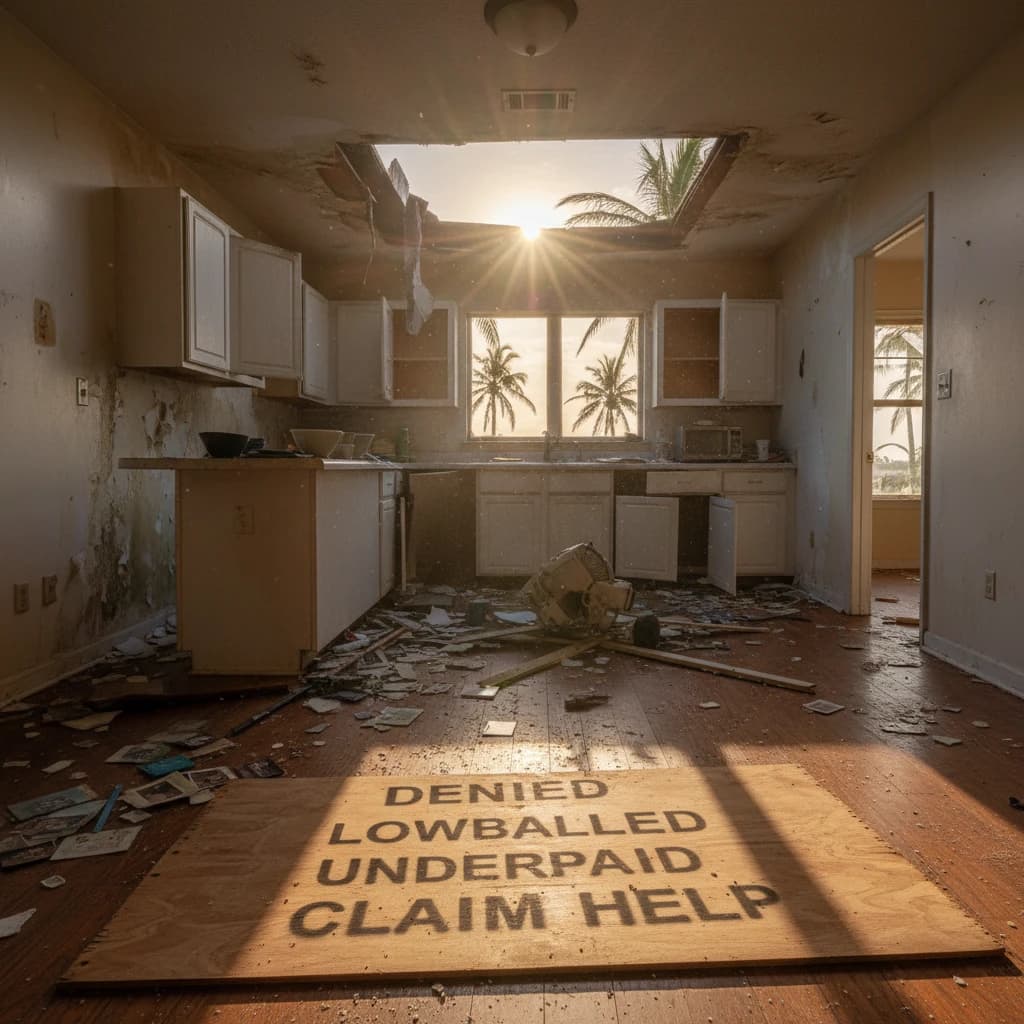
The three scenarios
Denial: the carrier paid $0 and issued a denial letter citing a specific basis. Lowball: the carrier offered a specific amount that's materially below the repair cost. Underpayment: the carrier paid something but missed scope, applied the wrong policy provision, or depreciated aggressively.
Each has a different playbook, but all three share a common truth in Florida: the carrier's first position is an opening position, not a final ruling. Denials get reversed, lowball offers get corrected, and underpayments get supplemented, usually because the original number was built on an incomplete inspection or a misread policy provision.
What to do first
The hours and days after a denial or lowball matter more than most policyholders realize.
- Keep the denial or estimate in writing. Save the letter, the adjuster's estimate, and every email. The carrier's stated basis defines what you have to overcome.
- Do not throw anything away. Damaged materials, removed drywall, the failed pipe fitting, and your photos are evidence. Premature repairs erase proof.
- Stop arguing on the phone. Verbal back-and-forth with a desk adjuster rarely moves a denial. The record that matters is documented.
- Get an independent re-inspection. A full-scope re-estimate is the single most effective response to both denials and lowballs, because it converts disagreement into documentation.
Reading the denial basis and its counters
A denial letter is only as strong as the policy language it cites. The first task is to find the exact provision, exclusion, or condition the carrier is relying on, then test whether the facts actually fit it. Many Florida denials lean on broad labels, "wear and tear," "gradual," "pre-existing," "below deductible," that fall apart once the cause of loss is documented properly. We pull the policy, read the cited section against the loss facts, and identify whether the carrier has met its own burden or simply applied a convenient label. The table below maps the common bases to the counter that tends to work.
| Denial basis | Counter |
|---|---|
| Wear and tear | Specific event documentation; expert correlation; prior maintenance records |
| Excluded peril | Careful peril-definition parsing; cause-of-loss documentation |
| Insufficient documentation | Submit the missing documentation |
| Gradual / long-term | Timeline of discovery; plumber/contractor statement; sudden-event evidence |
| Below deductible | Full-scope re-estimate (often crosses the deductible threshold) |
| Late notice | Reasonable-notice argument per Florida case law; prompt-notice record |
| AOB violation | Direct policyholder representation (no AOB) |
For the wear-and-tear label specifically, see how carriers build and how policyholders rebut that argument in our breakdown of the wear and tear defense.
Common lowball patterns
- Scope missing entire rooms or areas
- Unit pricing set to Xactimate defaults instead of Florida-current
- Code upgrades not included
- Matching statute ignored
- ACV paid without RCV holdback track
- Overhead and profit (10-and-10) not applied when it should be
- Temporary repair / mitigation costs omitted
The matching issue is one of the most common sources of underpayment in Florida. When repaired and undamaged materials cannot reasonably be matched, the matching statute can require the carrier to pay for matching contiguous areas, not just the damaged spot.
How carriers underpay
Underpayment usually is not a single big mistake; it is an accumulation of small ones. Scope is built fast from limited photos. Line items get dropped. Depreciation is applied aggressively, and the recoverable holdback is never explained to the policyholder. Code-required upgrades are left out. Mitigation and temporary-repair costs are treated as the policyholder's problem. Individually each item looks minor; together they can move a real number well below what the policy owes. A line-by-line re-estimate is what exposes the gap.
Florida deadlines that protect you
Florida law sets the clock on both sides of a claim, and several of those deadlines work in the policyholder's favor.
- Pay or deny. Under Fla. Stat. 627.70131, the carrier generally must pay or deny a property claim within a set statutory window after receiving notice. Missed or stalled responses are themselves leverage.
- Supplemental and reopened claims. Under Fla. Stat. 627.70132, there is a statutory window to bring a supplemental or reopened claim after the date of loss when additional damage emerges. Filing within the window preserves the right to recover more.
Because these windows are time-limited and have changed in recent years, the practical rule is simple: act early and confirm your specific policy's deadlines rather than assuming.
Reversal tools under Florida law
- Supplemental claim (Fla. Stat. 627.70132): 18 months from date of loss. Preserves policy limits; no denial of the original claim required.
- Reopened claim: 1 year from date of loss for new-claim notice; the claim can be "reopened" if additional damage emerges.
- Appraisal invocation: most Florida HO-3 policies include an appraisal clause. Either party may invoke. Three-appraiser panel (two parties' appraisers + an umpire) sets the amount of loss.
- DFS mediation (Fla. Stat. 627.7015): state-sponsored, low-cost, non-binding. Often resolves in a single session.
- Civil Remedy Notice (Fla. Stat. 624.155): statutory bad-faith notice. Carrier has 60 days to cure or face potential bad-faith exposure.
Appraisal vs the litigation path
When the disagreement is about the amount of loss, not whether coverage exists, appraisal is usually the faster, lower-cost route, and it keeps the dispute out of court. When the fight is about coverage itself, or when bad-faith conduct is in play, the Civil Remedy Notice and an attorney path may be the better fit. We often start with DFS mediation because it can resolve a lowball in one session before either side spends real money. Choosing between these tracks is a judgment call; our guide on a public adjuster vs an attorney in Florida explains when each makes sense.
How Ocean Point handles denied / underpaid claims
- Denial-letter review. Identify the exact basis; parse the policy language cited.
- Full re-estimate in Xactimate with Florida-current pricing.
- Policy review for missed coverages, endorsements, and sublimits.
- Counter-documentation: expert reports, photos, timelines as needed.
- Submission: supplemental, reopening, or direct demand letter depending on the situation.
- Escalation: appraisal, mediation, or CRN if the carrier maintains the position.
Is a denial really reversible?
Often, yes. A denial reflects the carrier's reading of the file as submitted. New documentation, a corrected scope, and the right policy provision frequently change the outcome.
Will reopening a claim cost me my coverage?
No. A supplemental or reopened claim filed within the statutory window pursues what the policy already owes; it does not waive your rights.
What does this cost me?
Ocean Point works on a contingency basis, no recovery, no fee, within Florida's public-adjuster fee limits under Fla. Stat. 626.854.
Who leads denial / underpayment claims
Eli Goins (FL DFS #P159790) leads complex denials, appraisals, and CRN filings. The full team supports across claim types.