
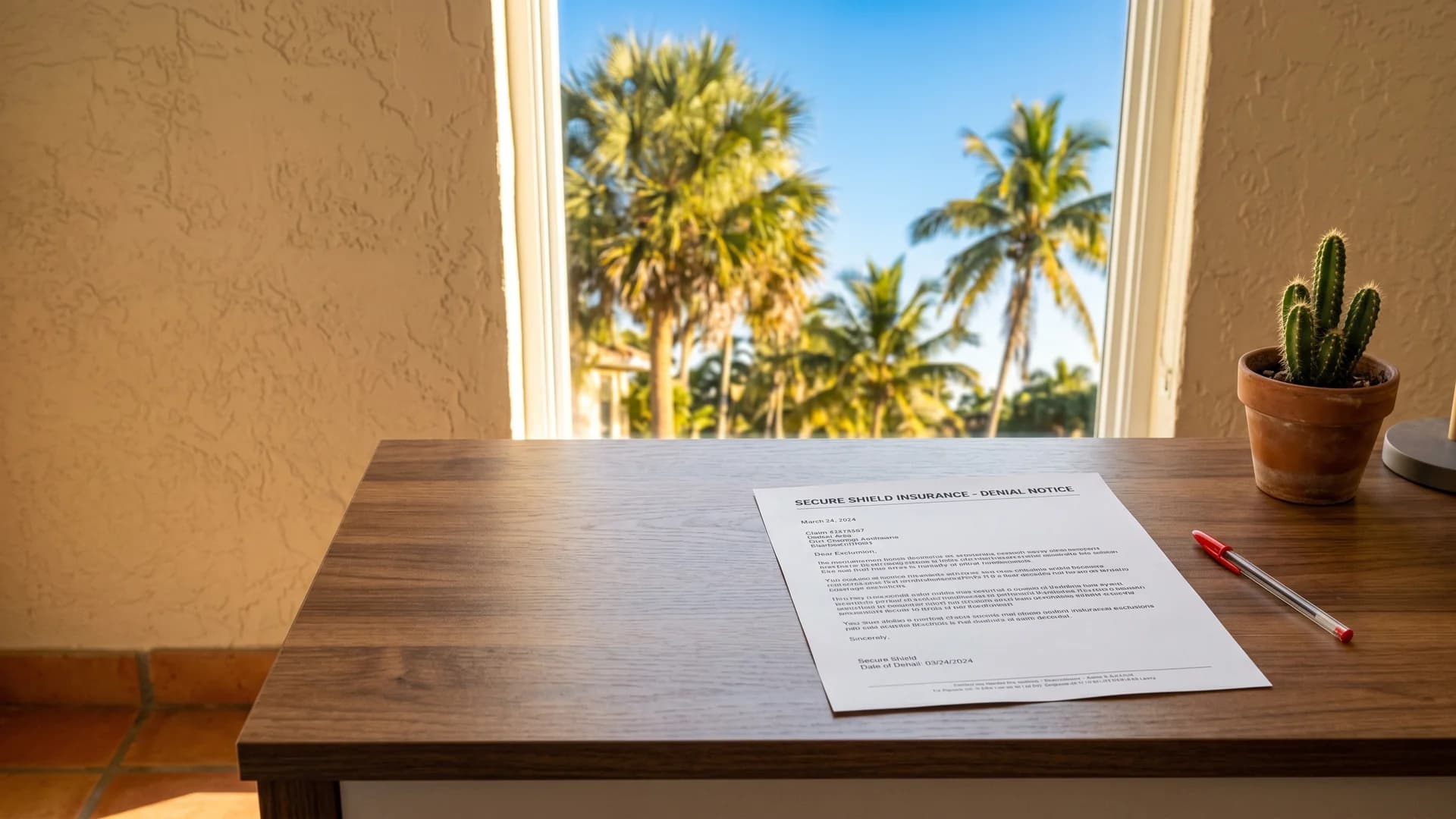
Florida denial reversal playbooks
Short answer: Reversing a Florida insurance claim denial starts with reading the denial letter closely, identifying the exact ground the carrier cited, and rebutting it with evidence: dated photos, an expert report, a line-item repair estimate, and your policy language. Many denials are overturned or reduced to partial approvals once the policyholder challenges the stated basis directly.
A denial letter is the insurer's opening position, not the final verdict. In Florida, many denied property claims can be challenged, reopened, and turned into payment once a policyholder understands the exact ground the carrier cited and answers it with evidence. This hub frames how denials work, why carriers issue them, and the practical steps for pushing back, then points you toward the subtopic that matches your situation.
Why Florida claims get denied
Most denials rest on a short list of recurring grounds. Carriers point to wear and tear or lack of maintenance to argue the damage was gradual rather than sudden and accidental. They invoke policy exclusions, lean on causation disputes (for example, wind versus flood, or pre-existing versus storm damage), or rely on an engineering report that reaches a convenient conclusion. Others cite late reporting, a missed duty after loss, or insufficient documentation. Each ground has a counter, and naming the real reason is the first step toward reversing it.
How to challenge the denial
Reversing a denial is an evidence exercise. You read the denial letter against your actual policy, separate what is genuinely excluded from what the adjuster simply did not credit, and rebuild the loss with photos, moisture readings, a detailed line-item estimate, and your own expert opinion when the carrier's engineer overreached. A well-supported response can overturn the denial outright or convert it into a partial approval that pays the covered portion. Where the file shows delay, shifting reasons, or a thin inspection, those patterns are worth documenting.
Get your denial reviewed
The subtopics below go deeper on each scenario: wear-and-tear findings, policy exclusions, engineering-report denials, late reporting, maintenance arguments, causation disputes, documentation gaps, challenging the denial letter, and reopening a closed claim. If your claim was denied or underpaid, a focused second look often surfaces coverage the first review missed. Ocean Point Claims represents Florida policyholders only, never insurers, and works on a no recovery, no fee basis, so you can have your denial letter and policy reviewed before you decide your next move.
Frequently asked questions
Can a denied Florida insurance claim be reopened?
How long do I have to challenge a denial in Florida?
Can a full denial become a partial payment?
Can I dispute the insurer's engineering report?
Should I hire a public adjuster after a denial?
Ready to talk to a licensed Florida public adjuster?
☎ (888) 824-1306Free claim review. No recovery, no fee. Answered 24/7.
Get a free claim review- License
- FL DFS #W829547
- Experience
- 21 years · 500+ mediations
- Rating
- 4.9★ (89 Google reviews)
- Fee
- No recovery, no fee