
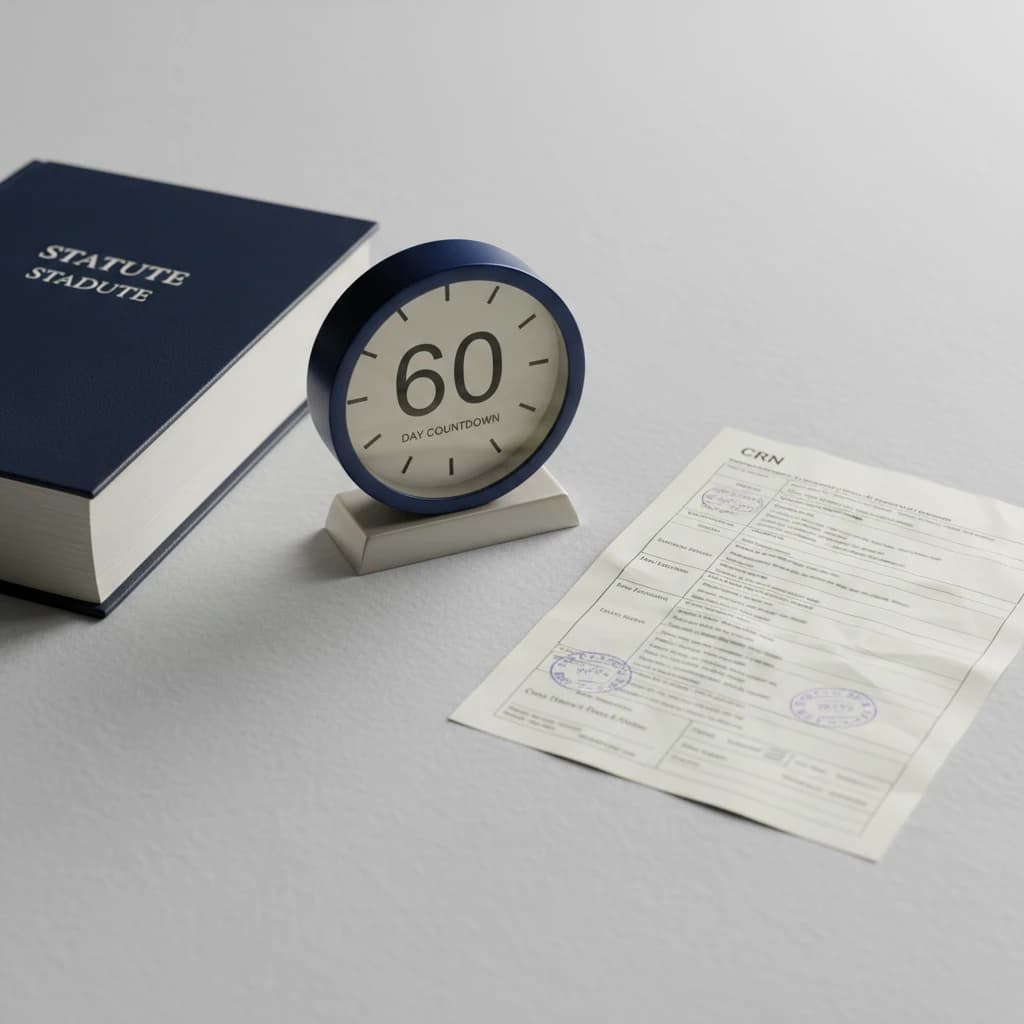
Short answer: According to Fla. Stat. 624.155, before you can sue a Florida insurer for bad faith you must file a Civil Remedy Notice that names the violation and gives the carrier 60 days to cure. If it cures, the claim gets paid; if it fails to cure within 60 days, you can pursue bad-faith damages that often exceed the policy limits.
What does Fla. Stat. 624.155 do?
Fla. Stat. 624.155 creates a cause of action against Florida insurers for bad-faith conduct: specifically, failure to settle in good faith, failure to pay when liability is reasonably clear, and other enumerated violations. It is the statute that can turn an unreasonable claim decision into liability beyond the policy limits.
What is a Civil Remedy Notice (CRN)?
Before a bad-faith lawsuit can be filed, the policyholder must file a Civil Remedy Notice with the DFS and the carrier. The CRN identifies the specific statutory violations alleged, which starts a 60-day clock. Naming the exact violation matters: a vague notice gives the carrier room to argue it was never put on notice.
How does the 60-day cure period work?
Once the CRN is filed, the carrier has 60 days to cure: pay the claim correctly, address the violation, and make the policyholder whole. If it cures in time, the claim gets paid and no bad-faith action follows. If it fails to cure within 60 days, the policyholder can proceed with a bad-faith action seeking the damages the insurer's conduct caused, often exceeding the policy limits.
| Step | What happens | Timing |
|---|---|---|
| File the CRN | Policyholder files with DFS and the carrier, naming the specific violation | Before any bad-faith suit |
| Carrier cure window | Carrier can pay the claim correctly or fix the violation | 60 days from filing |
| Cured in time | Claim gets paid; no bad-faith action follows | Within 60 days |
| Not cured | Policyholder may file a bad-faith action for the damages caused | After 60 days |
Key takeaway: the 60-day cure window is the gate, so a bad-faith suit is not available until it closes without a cure.
What qualifies as bad faith?
Bad faith is more than a claim decision you disagree with; it is conduct that breaches the insurer's duty of good faith. Common examples:
- Refusing to pay when liability is reasonably clear
- Failing to settle when possible and in the insured's best interest
- Missing statutory response deadlines without justification (see Fla. Stat. 627.70131)
- Misrepresenting material facts or policy provisions
- Acting as a material violation of the insurer's duty of good faith
How does Ocean Point handle CRNs?
Ocean Point prepares CRNs under 624.155, one of our core services. We document the alleged violations, cite the statute, and file with DFS. When the carrier cures, the claim gets paid. When the carrier does not cure, we coordinate with policyholder counsel to pursue the bad-faith action.
Who this is for, and should you file a CRN?
A Civil Remedy Notice is the right tool when the carrier has clearly crossed a line: refusing to pay when liability is reasonably clear, missing the statutory deadlines without justification, or misrepresenting your policy. It is not a routine negotiating letter, and filing one without a documented violation rarely helps.
Handle a slow-but-responsive claim with direct follow-up first. Bring in a public adjuster or attorney when the file already shows a curable violation, because a well-documented CRN that cites the exact statute is what starts the 60-day clock and pushes the carrier to pay or expose itself to bad-faith damages. Public adjuster fees in Florida are capped by law (Fla. Stat. 626.854).
Bottom line: the CRN only works if the violation is real and documented; name it precisely, give the carrier its 60 days, and keep the record.