
Skip to content
Ocean Point Claims Company
Ocean Point Claims:claim documentation requirements

Claim Documentation Requirements

Florida insurance claims succeed or fail on documentation quality. This is the complete checklist: what to gather, how to organize it, and how to present it to the carrier for maximum recovery.
Reviewed by Eli Goins, FL DFS License #P159790 · Last updated
By Eli Goins · FL DFS #P159790 · Reviewed: · 1 min read

Short answer: A Florida insurance claim needs your full policy (declarations and endorsements), written notice of loss, dated photos and video of the damage, a detailed scope with measurements, a contents inventory, mitigation and repair receipts, expert reports when needed, and a log of all insurer communications. Organize everything by category and keep copies of every submission.

Policy documents

  • Declarations page (current)
  • Full policy form (current)
  • All endorsements
  • Any personal articles floaters or schedules
  • Prior year's policy if the loss occurred shortly before renewal

Loss notification

  • Date, time, and description of the event
  • First-notice-of-loss confirmation from the carrier
  • Claim number
  • Any incident reports (police, fire department)
Ocean Point Claims:claim dispute escalation paths

Damage documentation

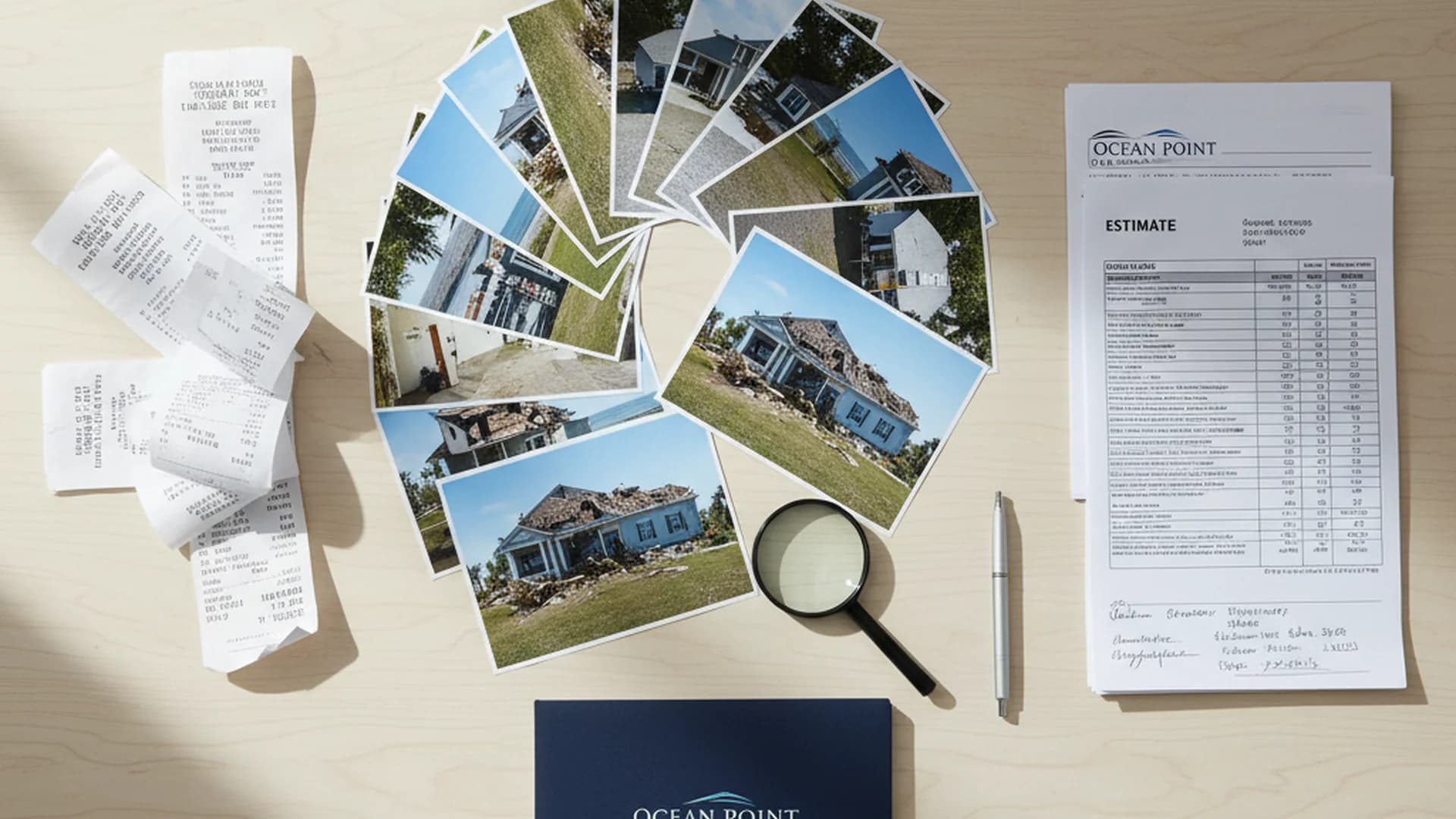
  • Photographs: wide, medium, and close-up of every affected area
  • Video walkthrough with narration
  • Date- and timestamped
  • Taken before any mitigation or repair
  • Drone imagery for roofs and large-scale exterior losses
  • Matterport 3D capture for total losses

Scope and measurements

  • Room-by-room measurements
  • Xactimate sketch (or contractor equivalent)
  • Specific materials identified (make, model, SKU where possible)
  • Discontinued materials noted (triggers matching statute)
Ocean Point Claims:insurance claim negotiation strategies

Expert reports when warranted

  • Industrial hygienist (mold and water)
  • Structural engineer (collapse, sinkhole, foundation)
  • Forensic engineer (cause and origin)
  • Fire investigator (fire origin and cause)
  • Electrician (lightning/surge)
  • Plumber (leak source)

Contents inventory

  • Room-by-room list
  • Descriptions with brand, model, age where known
  • Purchase receipts when available
  • Replacement cost quotes for non-trivial items
  • Photographs of each item where possible

Ocean Point Claims:claim dispute escalation paths

Mitigation and repair records

  • Mitigation contractor invoices
  • Emergency repair receipts
  • Tarps, board-up, water extraction, dry-out
  • Daily drying log with moisture readings
  • Any temporary relocation costs (ALE)

Communications

  • Every email to/from the carrier
  • Phone log with dates, names, and summary
  • Any correspondence from the carrier (estimate, denial, settlement letter)

Ocean Point Claims:insurance claim negotiation strategies

Financial records (commercial / BI)

  • 3 years of monthly P&Ls
  • Monthly bank statements
  • Tax returns
  • Payroll registers
  • Customer / invoice history

How to organize it

Create a single claim binder or cloud folder with:

  1. Policy folder
  2. Event / Loss folder
  3. Photos & Video folder
  4. Scope & Estimate folder
  5. Expert Reports folder
  6. Contents folder
  7. Mitigation / Repair folder
  8. Communications folder (dated chronologically)
  9. Financial folder (commercial only)

Frequently asked questions

What photos and video should I take after property damage in Florida?
Document every damaged area with clear, dated photos and video before any cleanup or repairs begin. Capture wide shots showing the full room or structure and close-ups showing specific damage, model numbers, and serial numbers. Keep the originals with their metadata intact, because timestamps help establish when the loss occurred and support your scope of damage.
How soon do I have to report a claim and submit documentation in Florida?
Under 627.70132, you generally have one year from the date of loss to give your insurer notice of a new or reopened claim, and 18 months to file a supplemental claim. Once you report, 627.70131 requires the insurer to acknowledge within 7 days, inspect within 30 days, and pay or deny within 60 days. Submitting complete documentation early helps keep those response deadlines on track.
What is a scope of loss and why do I need one for my claim?
A scope of loss is an itemized description of the damage and the work required to repair it, including measurements, materials, and quantities. It turns your photos into a line-item basis for your claim and lets you compare your figures against the insurer's estimate. Where repairs cannot reasonably match undamaged adjacent areas, 626.9744 can support including those items in your scope.
How do I prove the value of my damaged contents and personal property?
Create a contents inventory listing each damaged item with its description, age, brand, and replacement cost. Support it with photos, receipts, owner's manuals, or credit card and bank statements where you have them. The more detail you provide per item, the harder it is for the insurer to undervalue or dispute your personal property claim.
How should I organize all of my Florida claim documentation?
Group your records by category: policy documents, loss notice, photos and video, scope and estimates, contents inventory, mitigation and repair receipts, expert reports, and communications. Keep a dated log of every call, email, and letter with your insurer. Save copies of everything you submit, so you can show exactly what was provided and when.

Related

Reviewed by Eli Goins, FL DFS License #P159790 · Last updated

Ready to talk to a licensed Florida public adjuster?

(888) 824-1306

Free claim review. No recovery, no fee. Answered 24/7.

Get a free claim review
License
FL DFS #W829547
Experience
21 years · 500+ mediations
Rating
4.9★ (86 Google reviews)
Fee
No recovery, no fee
📞 (888) 824-1306Free Claim Review