
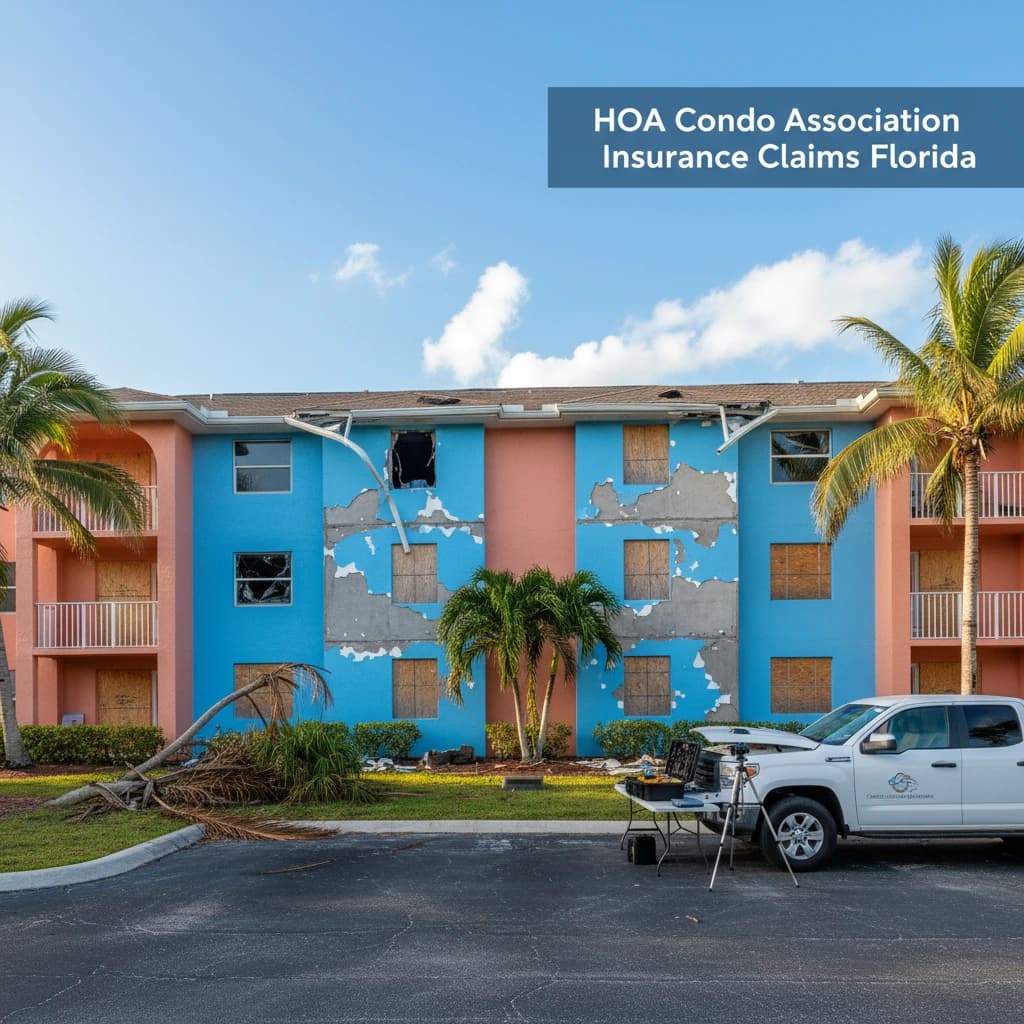
What associations typically insure
Association master policies in Florida typically cover:
- Common elements: exterior walls, roofs, hallways, lobbies, elevators, parking structures, pool decks, clubhouses
- Limited common elements: balconies, patios, assigned parking (depending on the declaration)
- Building systems: elevators, pumps, boilers, central HVAC, fire suppression
- Grounds: landscaping, fencing, gates, lighting
What's covered by the unit owner's HO-6 policy varies by declaration: typically "bare walls" (owner covers everything inside the unit's drywall) to "all-in" (association covers fixtures and finishes as originally installed). The declaration, not the insurance policy, draws this line, which is why we read it first.
Master policy versus unit-owner coverage
Almost every dispute on an association loss comes back to one question: where does the master policy stop and the unit owner's coverage begin? On a "bare walls" declaration the association insures the structure to the unsurfaced interior, and the owner covers drywall, flooring, and finishes; on an "all-in" declaration the master policy reaches the fixtures and finishes as originally built. Carriers exploit the gap between these readings, treating interior damage as the owner's problem when the declaration makes it the association's, or vice versa, so the damage lands in a no-man's-land nobody pays. We reconcile the master policy, the declaration, and each affected owner's HO-6 policy so the same damage is not denied from two directions.
Why association claims are commonly underpaid
- Scope fragmentation. Field adjusters document unit-by-unit damage but miss envelope and common-element scope.
- Matching statute (Fla. Stat. 626.9744) ignored. Discontinued cladding, roofing, or fixture lines trigger continuous-area replacement: often forcing full-building scope instead of unit-by-unit. See the matching statute breakdown.
- Code upgrades omitted. Post-Surfside, Florida's structural and life-safety code landscape has shifted. Post-loss rebuilds often trigger code upgrades across common elements.
- Loss of use of common amenities. Pool, clubhouse, gym closure creates a Loss of Use or Fair Rental Value claim that's often forgotten.
- Coordination failures. Board, property manager, and unit owners submit conflicting documentation; the carrier uses the inconsistency to cap the claim.
These are the same patterns behind any underpaid claim, compounded on a multi-building loss where the dollars and stakeholders are larger.
Special assessments and the board's fiduciary duty
When a master-policy claim is underpaid, the shortfall does not disappear. It lands on the owners as a special assessment to cover the gap between what the carrier paid and what the repair costs, which is exactly the outcome a board is supposed to prevent.
This is where fiduciary duty matters. Directors have an obligation to pursue the recovery the association is owed before they ask owners to pay out of pocket. Accepting an early, incomplete carrier offer and then assessing the membership is the kind of decision that draws owner challenges and director liability. We help boards close the funding gap through the claim rather than the assessment, and we support recovery on an assessment already levied through special assessment recovery.
How Ocean Point handles association claims
- Board engagement. We work directly with the board and property manager to coordinate documentation.
- Declaration review. The association declaration controls what is "common element" versus "unit-owner property": this governs everything.
- Full-building scope documentation. Matterport or drone capture of every common element and every affected unit.
- Matching and code analysis for all affected materials.
- Unit-owner coordination. Where owners have parallel HO-6 claims, we align them so the master and unit claims reinforce rather than contradict each other.
- Escalation. Most association policies include an appraisal clause; we also use DFS mediation when the carrier holds an unsupported position. See our appraisal and umpire service and mediation.
Florida deadlines and statutes for association claims
Association claims live under the same statutory clock as any Florida property claim, and missing a deadline can forfeit valid scope.
- Notice of claim. New property claims must be reported within the window set by Fla. Stat. 627.70132, with a shorter window for supplemental and reopened claims; roof-related claims carry their own timing under the same statute, covered in our roof-claim deadlines breakdown.
- 60-day pay-or-deny. Under Fla. Stat. 627.70131, the carrier generally must pay or deny a claim within 60 days of notice, absent factors beyond its control.
- Matching. Fla. Stat. 626.9744 governs whether a carrier must replace undamaged but visually continuous materials, which on a multi-building roof or exterior is the difference between a patch and a full elevation.
- Supplemental and reopened claims. When a board discovers additional damage after the first payment, the supplemental window preserves the right to recover it through our supplemental claim preparation process.
Only an attorney can give legal advice on these deadlines; we flag them so the board does not lose a remedy.
Large multi-building and catastrophic losses
Hurricane, hail, and fire losses across multiple buildings are where association claims get hardest. Scope spreads across dozens of roofs and elevations, and the loss often qualifies as a catastrophic loss. For named-storm damage, our hurricane claim approach pairs full-property capture with wind-versus-other-cause analysis so the carrier cannot shrink the claim one building at a time. When a board and carrier are far apart on the amount of loss, appraisal or a Civil Remedy Notice is often faster than a contested file that sits.
Common pitfalls
- Signing a release too early, while unit owners still have unresolved damage.
- Missing the notice deadline on new claims under Fla. Stat. 627.70132.
- Failing to invoke the supplemental window when scope gaps surface later.
- Using the association's insurance agent as the claim advisor. The agent is not a licensed public adjuster and has relationship incentives with the carrier.
Common questions about association claims
Who files the claim, the board or the owners?
The association files for common-element and master-policy damage; owners file HO-6 claims for what the declaration assigns to them. The two should be coordinated, not run in isolation.
Does invoking appraisal waive other rights?
Appraisal resolves the amount of loss, not coverage. We confirm what the panel can and cannot decide before a board invokes it, and we coordinate with association counsel rather than replace them. See public adjuster versus attorney.
Who leads association claims
Eli Goins (FL DFS #P159790) leads HOA, condo association, and mixed-use building claims. Ocean Point represents Florida associations ranging from small 6-unit complexes to 200+ unit master-associations.
A documented result
- $678,026 the carrier initial offer
- $1,793,588.67 what Ocean Point recovered for the association
Read the full case: the Fort Myers Beach condominium association claim