
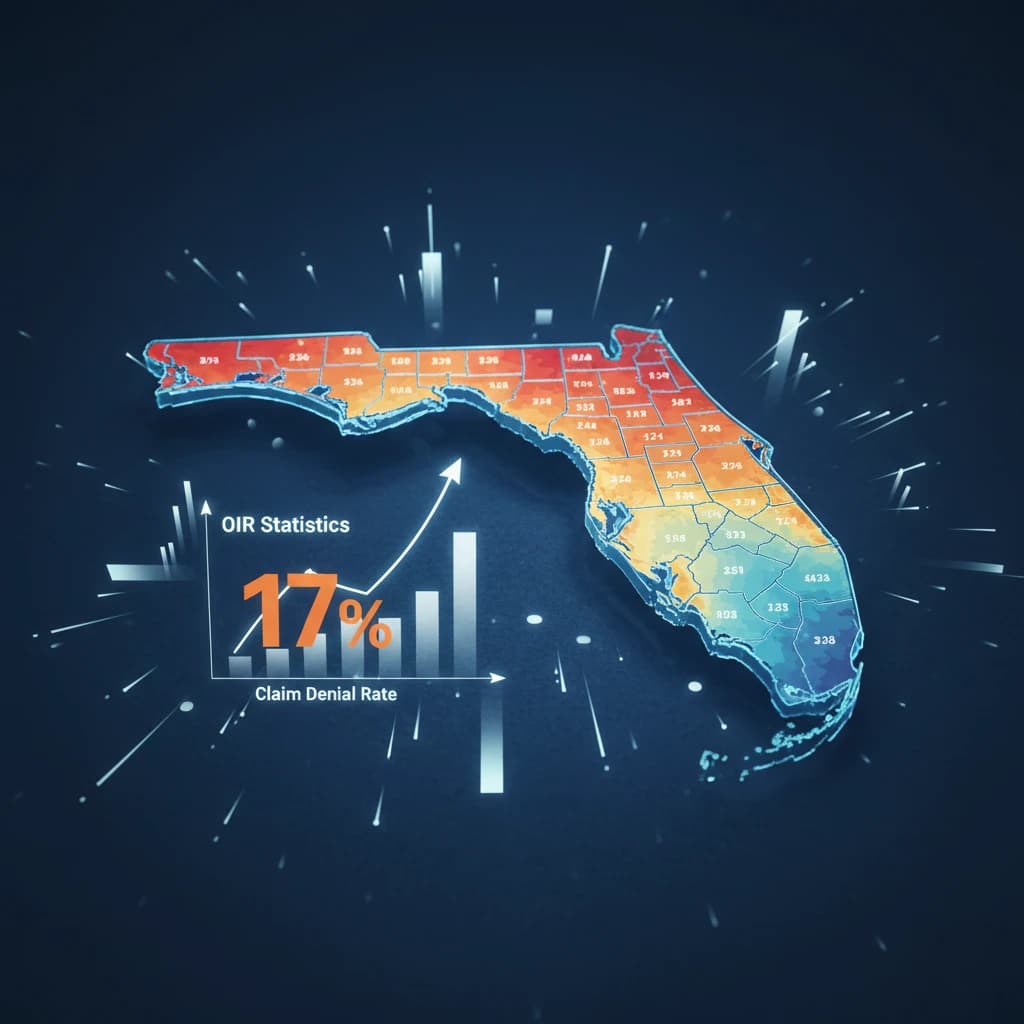
Florida OIR data at a glance
The Florida Office of Insurance Regulation (FLOIR) publishes hurricane claim data in the weeks and months after major events, updating each storm as claims mature. This page summarizes FLOIR's published figures for the two most recent major Florida hurricanes, with the FLOIR data-cut date noted on each figure.
A 2010 Florida OPPAGA study (Report No. 10-06) of Citizens Property Insurance Corporation claims found that policyholders represented by public adjusters received materially higher settlements, with the largest differences on hurricane claims (oppaga.fl.gov/Documents/Reports/10-06.pdf; individual results vary). The statutory deadlines that govern these claims are objectively fixed: under Fla. Stat. 627.70131, a Florida insurer must acknowledge a claim within 7 days, begin its investigation within 7 business days of receiving proof of loss, conduct any physical inspection within 30 days, and pay or deny within 60 days, with statutory interest on late payment. If a carrier handles a claim in bad faith, Fla. Stat. 624.155 requires a Civil Remedy Notice that gives the insurer 60 days to cure before a bad-faith action can proceed.
Hurricane Helene (2024)
As of FLOIR's June 10, 2025 data cut, 50,138 of 155,182 reported Hurricane Helene claims were closed without any insurer payment, about 32% of all reported claims, or roughly 35% of the claims that had closed. FLOIR reports 92.5% of Helene claims had closed by that date (floir.gov/home/hurricane-helene).
Closed without payment is not the same as a disputed denial. Of Helene claims closed without payment, FLOIR attributes 33% to damage below the policy deductible and 20% to flood-coverage denials, with the rest spread across withdrawn claims, claims opened in error, no policyholder contact, and other administrative reasons (FLOIR, April 9, 2025).
Hurricane Milton (2024)
As of FLOIR's December 9, 2025 data cut, 134,177 of 385,146 reported Hurricane Milton claims were closed without payment, about 35% of all reported claims, or roughly 38% of the claims that had closed. FLOIR reports 92.0% of Milton claims had closed by that date (floir.gov/home/hurricane-milton).
Of Milton claims closed without payment, FLOIR attributes 41% to damage below the deductible; flood-coverage denials were a much smaller share, roughly 4 to 5% (5,998 of 134,177 as of the December 9, 2025 cut) (FLOIR, April 9, 2025).
What these numbers mean for policyholders
A meaningful share of closed-without-payment outcomes are defensible. A meaningful share are not. Without a documented re-estimate, you often cannot tell which category your claim falls into.
Specifically:
- Below-deductible outcomes often rest on a partial scope. A re-estimate that captures full scope frequently clears the deductible threshold.
- Flood-coverage denials rest on a cause-of-loss determination. Wind-driven rain is generally covered under wind policies; flood is not. The distinction is documented and argued.
What Ocean Point sees
In our experience, many of the post-storm denials we review can be reversed in full or in significant part once the loss is properly documented and the policy language is enforced. The reversal path, documentation, re-estimation, sometimes an engineer report, sometimes mediation, is the core Ocean Point workflow.
Source notes
FLOIR figures above are from the Florida Office of Insurance Regulation catastrophe reporting at floir.gov/tools-and-data/catastrophe-reporting, the per-event pages Hurricane Helene and Hurricane Milton, and FLOIR's April 9, 2025 statement on closed-claim reporting. Each figure is stamped with its FLOIR data-cut date; as events age, these counts and rates shift.