
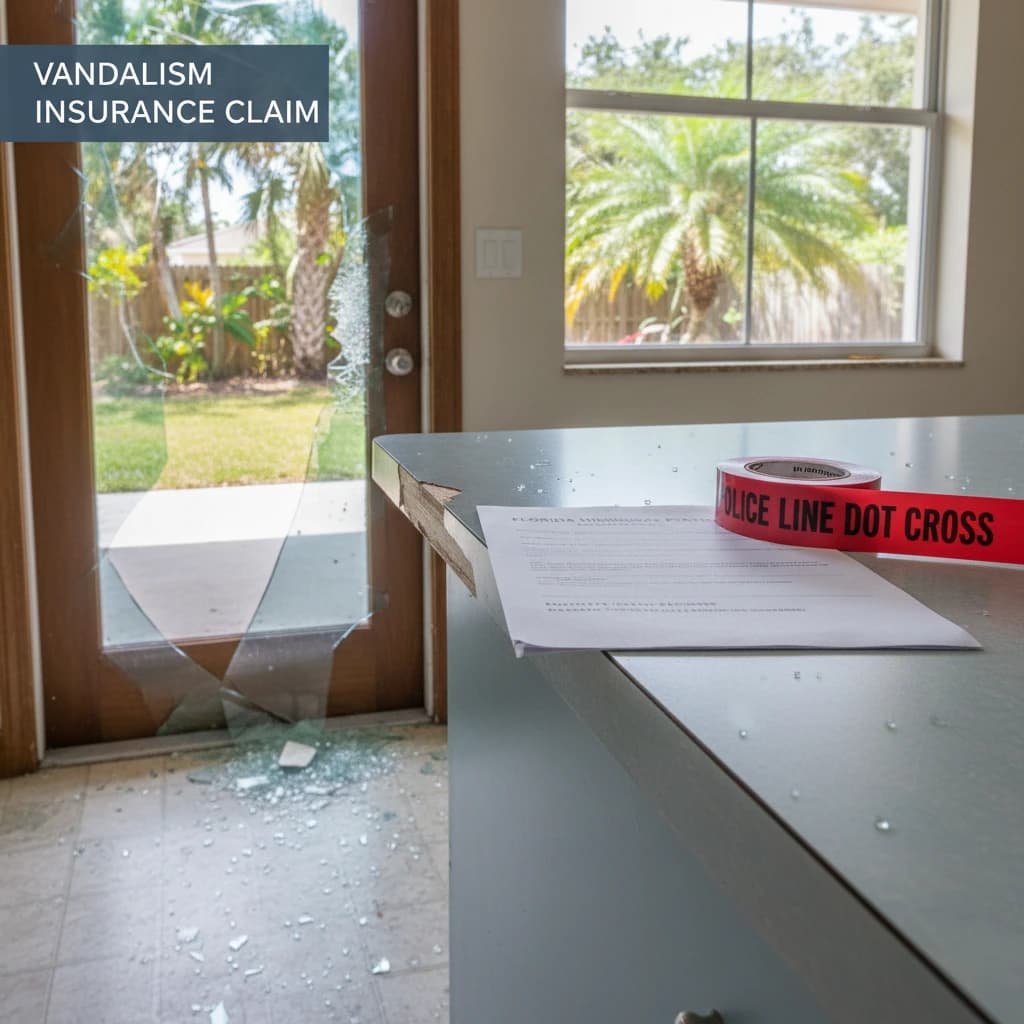
What vandalism / theft coverage includes
Vandalism and malicious mischief are named perils on most Florida HO-3 homeowner and commercial property forms, alongside theft and break-in damage. Coverage typically reaches:
- Break-in damage: forced doors, broken windows, damaged frames and hardware
- Interior damage: destruction during the break-in (broken furniture, damaged walls)
- Stolen items: personal property with limits and sublimits (jewelry, firearms, cash)
- Vandalism and malicious mischief: graffiti, smashed fixtures, destruction of walls, flooring, and built-in appliances
- Tenant damage: intentional destruction by a tenant (commercial / landlord policies)
- Locksmith / re-keying: some policies; others require a specific endorsement
Damage done to take something and damage done purely to destroy (graffiti, slashed drywall, broken fixtures) are both usually covered, but carriers scope them differently, and the malicious-mischief portion is often left out of the first estimate.
The police report is non-negotiable
Without a police report, most carriers deny theft and vandalism claims entirely. In the first 24 to 72 hours:
- Call law enforcement and get a case number. List every stolen item and every act of vandalism; omissions hurt the claim. File an amended report if you find more later, and request a written copy for the insurance file.
- Photograph everything before you touch it: wide shots of each room, then close-ups of every broken fixture, graffiti tag, and entry point.
- Make only the temporary repairs needed to secure the property (board windows, change locks, tarp openings). Florida policies require you to protect the property from additional damage, and those reasonable emergency costs are usually reimbursable, so keep receipts.
- Do not throw away damaged items or scrub graffiti until they are documented and seen by the adjuster.
A police report establishes that an intentional criminal act occurred, which separates a covered vandalism loss from an excluded wear-and-tear dispute, and date-stamps the loss.
The vacant-property trap
Vandalism claims land disproportionately on vacant and unoccupied buildings: rentals between tenants, inherited homes, properties for sale, and seasonal residences, which is also where coverage gets thin. Most standard forms suspend or sharply limit vandalism, malicious mischief, and glass-breakage coverage once a dwelling has been vacant beyond the period stated in the policy. Whether the property was legally "vacant" or merely "unoccupied," and for how long, often controls the entire claim. Landlords and snowbirds should read their vacancy provision early, as an endorsement is sometimes available to keep the coverage in force. If a vacancy denial has already landed, see Claim Denied for next steps.
Why theft and vandalism claims are commonly underpaid
- No proof of ownership. For high-value items (jewelry, electronics, firearms), the carrier demands proof the item existed before it will pay.
- Sublimits. Jewelry sublimit ($1,500-$2,500), firearms sublimit ($2,000-$2,500), and cash sublimit ($200) cap recovery unless items are scheduled on a floater.
- Depreciation applied aggressively. Stolen electronics and appliances depreciated to near-zero, with replacement-cost provisions often not invoked correctly.
- Structural and vandalism damage missed. Break-in repairs and malicious-mischief repairs (graffiti removal, repainting, replacing broken fixtures) get rolled up as "incidental" when they are a separately reimbursable scope.
- Business-property sublimit. Work-from-home equipment may fall under the $2,500 business sublimit unless properly scheduled.
- Cause reclassified as excluded. Carriers recast deliberate damage as long-term wear or neglect to move the loss outside coverage.
If your offer reflects any of these, our Underpaid Claim walkthrough explains how we rebuild the number.
Vandalism vs excluded-cause disputes
The hardest fights are not about whether vandalism is covered but about whether the damage in front of the adjuster is vandalism at all. A carrier facing a broken pipe, water-stained ceiling, or cracked tile in a vacant unit may argue the cause was a slow leak, deferred maintenance, or pre-existing deterioration rather than a malicious act. The police report, witness statements, the pattern of damage, and the timeline all become evidence. When the parties disagree on the dollar value rather than coverage, the policy's appraisal clause can resolve the amount of loss without litigation. We document the cause so the "it was already like that" argument does not survive.
Florida deadlines that protect you
Florida law sets a clock on the carrier, not just on you. Under Fla. Stat. 627.70131, your insurer generally must pay or deny a property claim within 60 days of receiving notice, absent factors beyond its control, and must acknowledge and begin investigating within the shorter statutory windows that section sets. Missing these deadlines can carry consequences for the carrier, including interest, and a timely, well-documented file is what makes those protections usable. For how often Florida carriers underpay or deny, see our Florida Claim Denial Statistics page.
Documentation and proof of ownership
Bring or rebuild as much of this as possible:
- The police report and case number, plus any amendments
- Dated photos and video of every entry point, broken fixture, and act of vandalism
- A stolen-items inventory with descriptions, ages, and replacement prices
- Receipts for emergency board-up, lock changes, and tarping
- Your declarations page and any personal-articles floater or vacancy endorsement
Proof of ownership is usually the deciding factor on the stolen-items side, and it can be rebuilt even years later: photos from family gatherings and holidays; credit-card and bank statements from the purchase; appraisals for jewelry, art, and scheduled items; serial numbers for firearms and electronics; and tax returns showing home-office equipment.
How Ocean Point handles vandalism / theft claims
- Coordinate with law enforcement on the police report.
- Build a stolen-items inventory with proof-of-ownership documentation.
- Document structural and vandalism damage (break-in points, graffiti, broken fixtures, interior destruction) separately from the stolen-items claim.
- Review any personal-articles floaters, and check the vacancy provision before the carrier raises it.
- Negotiate depreciation and invoke RCV holdback as repairs and replacements complete.
Our public adjusting service runs this end to end, and our broader claim protocol shows how the steps tie together.
Common questions
Is graffiti or a smashed fixture covered if no one broke in?
Usually yes. Malicious mischief does not require a break-in, but vacancy limits and the cause-of-loss question still apply.
Should I hire a public adjuster or an attorney?
It depends on whether the fight is about the dollar amount or about coverage. Our public adjuster vs attorney overview explains when each fits.
Who leads vandalism / theft claims
Eli Goins (FL DFS #P159790) leads complex theft and vandalism claims. The full team supports across claim types.