
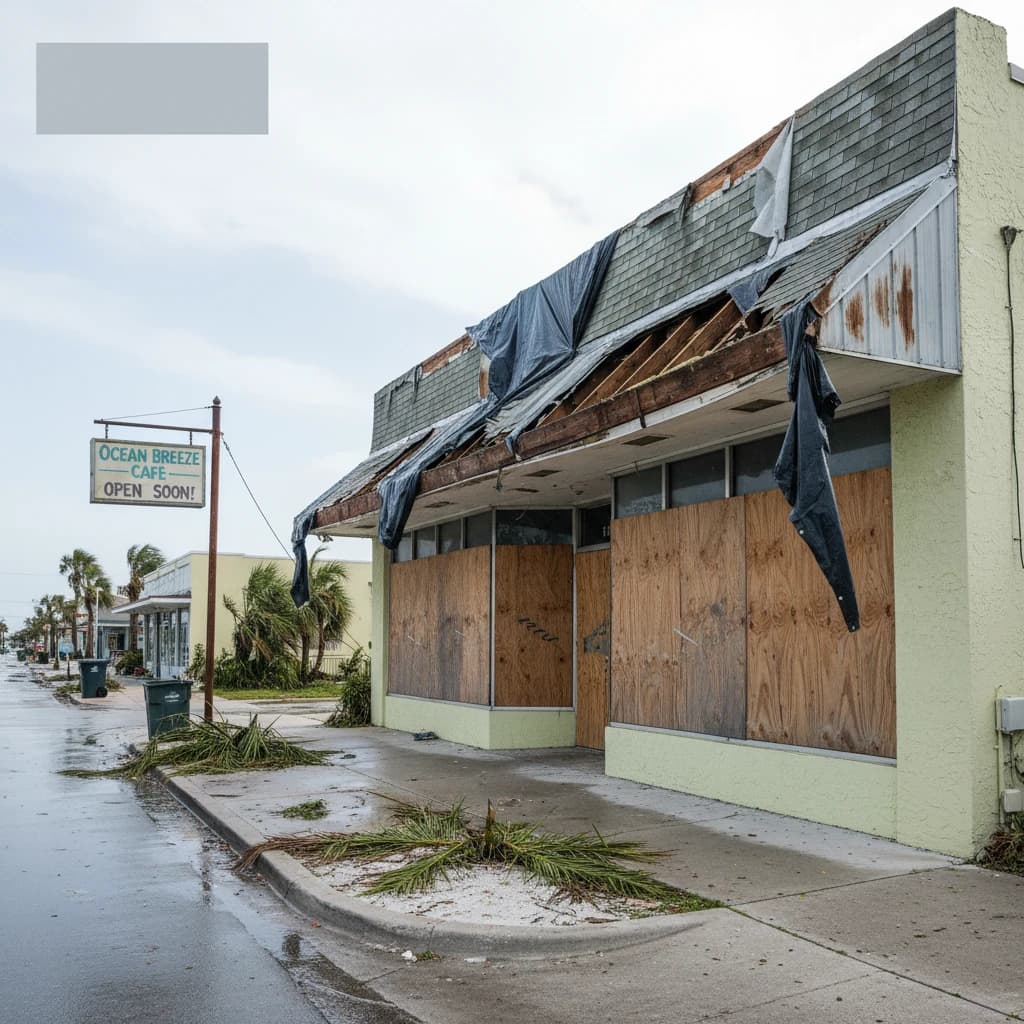
What BI coverage pays
Commercial BI coverage pays the net income the business would have earned during the period of restoration, plus ongoing operating expenses that continue regardless of operations. Unlike a building or contents claim, there is nothing physical to photograph, so the entire recovery turns on financial proof. Typical components:
- Lost profits: calculated from historical financials (monthly P&Ls, prior-year same-period)
- Continuing operating expenses: rent, utilities, insurance, minimum payroll, debt service
- Extra expense: the additional cost to continue operations at a temporary location or with workarounds
- Contingent BI: when the loss is at a supplier or major customer that affects your business
- Leader property: when a nearby anchor tenant's closure affects foot traffic
The policy aims to put the business in the financial position it would have occupied had the loss never happened. That is a projection, not a record of what happened, which is exactly why carriers contest it. For the residential version of displacement coverage, see Residential Loss of Use / ALE.
Period of restoration
The covered period runs from the date of loss until the property is or reasonably should have been repaired with reasonable speed. Typical carrier disputes:
- Start date: carrier argues the business could have operated partially; policyholder argues full shutdown
- End date: carrier argues the property is restored; policyholder argues equipment calibration, staff rehire, or customer return period extends it
- Extended period: most policies offer 30-60 days of extended BI after reopening; often forgotten
The phrase "should have been repaired" cuts both ways. Carriers use it to compress the period by assuming an idealized, delay-free reconstruction. In practice, Florida commercial rebuilds run into permitting backlogs, long-lead equipment, and labor shortages after a widespread storm. Documenting why the realistic timeline is longer than the carrier's hypothetical is one of the most valuable things an adjuster does on a BI file.
Watch the waiting period (time deductible) of 24, 48, or 72 hours that many policies apply before income loss is payable. It is a deductible expressed in time, not a flat percentage reduction across the whole claim, though carriers sometimes treat it that way. Civil-authority and ingress/egress provisions, which cover loss when a government order or blocked access stops business without direct damage to your building, carry their own sub-limits and day caps.
Why commercial BI claims are commonly underpaid
- Weak income documentation. Proving lost income requires clean monthly financials. Many small businesses submit bank statements and hope for the best: this gets heavily discounted.
- Contingent BI overlooked. A supplier fire, port closure, or upstream event can trigger BI even if your property is undamaged.
- Payroll treatment disputed. Ordinary payroll is generally excluded (you're not producing); key employee and minimum necessary payroll is often included.
- Period of restoration shortened. Carrier declares the business "able to reopen" when operational capacity isn't actually restored.
- Extra expense not claimed. Temporary location rent, expedited shipping, overtime to catch up: all covered, often missed.
- Saved expenses overstated. Carriers subtract costs the business "no longer incurs" while closed, then inflate that figure to shrink net loss; many of those expenses actually continued.
BI is the single most commonly underpaid commercial coverage precisely because every variable in the calculation is contestable. If the offer feels low, our claim underpaid walkthrough explains how to challenge it with the financial record rather than argument.
How carriers project revenue against you
The carrier's accountant builds a "but-for" revenue model: what the business would have earned absent the loss. Disputes cluster around the inputs. Carriers frequently pick a flat trailing average that ignores seasonality, which matters enormously in Florida tourism, hospitality, and snowbird-season retail. They may treat a growing business as flat or exclude one-time contracts that were on the books. The defense is contemporaneous evidence: confirmed reservations, signed contracts, prior peak-season P&Ls, and year-over-year growth from tax returns, rather than accepting the carrier's assumptions as neutral.
Florida deadlines and statutes
Commercial property claims run on the same statutory clock as residential ones. Under Fla. Stat. 627.70131, the insurer must acknowledge and begin investigating promptly and generally must pay or deny within the statutory window after receiving notice and proof of loss. For hurricane and windstorm losses, Fla. Stat. 627.70132 sets the deadline for initial notice and a shorter window for supplemental or reopened claims, so a BI shortfall discovered later still needs timely notice. Public-adjuster compensation is capped by Fla. Stat. 626.854. Treat these as live deadlines from the date of loss, because late notice gives the carrier a clean defense regardless of how strong the income proof is.
What to do immediately after the loss
- Give written notice to the carrier promptly and request the full policy, including all BI and extra-expense forms and endorsements.
- Start a dated extra-expense ledger on day one: every temporary cost, overtime hour, and expedited order.
- Preserve the financials a BI calculation needs before they get buried in the rebuild.
- Photograph and log the operational shutdown, not just the physical damage.
- Avoid giving a recorded statement estimating your losses before the numbers are built.
Documentation checklist
- 3 years of monthly P&Ls
- Monthly bank statements
- Tax returns (federal and state)
- Payroll registers
- Lease, utilities, insurance contracts (fixed costs)
- Customer order / invoice history (for contingent BI calculations)
- Seasonal adjustment factors (if the loss happened in a peak or low period)
How Ocean Point handles commercial BI claims
- Engage a forensic accountant from the outset (CPA with BI experience).
- Document the period of restoration with contractor schedule and staff return dates.
- Calculate lost net income with full backup (not bank-statement summary).
- Track extra expense in a dedicated ledger.
- Negotiate or escalate based on the financial record.
We pair this with loss consulting for complex operations and prepare a supplemental claim when the restoration period or extra expense outruns the first estimate.
Appraisal versus litigation
If the dispute is about the amount of the loss rather than whether coverage exists, many commercial policies allow appraisal, where each side names an appraiser and a neutral umpire resolves the difference. Appraisal can be faster than suit for a pure number disagreement, and our appraisal and umpire team handles it. When the carrier denies coverage outright, misapplies an exclusion, or acts in bad faith, that is a legal question for counsel, and the public adjuster versus attorney breakdown explains where each path fits.
Who leads commercial claims at Ocean Point
Eli Goins (FL DFS #P159790) leads commercial and mixed-use claims. Licensed Florida public adjuster representing commercial policyholders statewide.